Short answer: Some of Saigon's most rewarding eating happens on food streets outside the old centre. The four easiest for visitors are Vĩnh Khánh (seafood and snails, former District 4), the food alley at Hồ Thị Kỷ flower market (former District 10), Hà Tôn Quyền for dumplings (former District 11) and Phan Xích Long (Phú Nhuận). All are a short ride-hailing trip from Bến Thành and are busiest in the evening.
What a "food street" means in Saigon
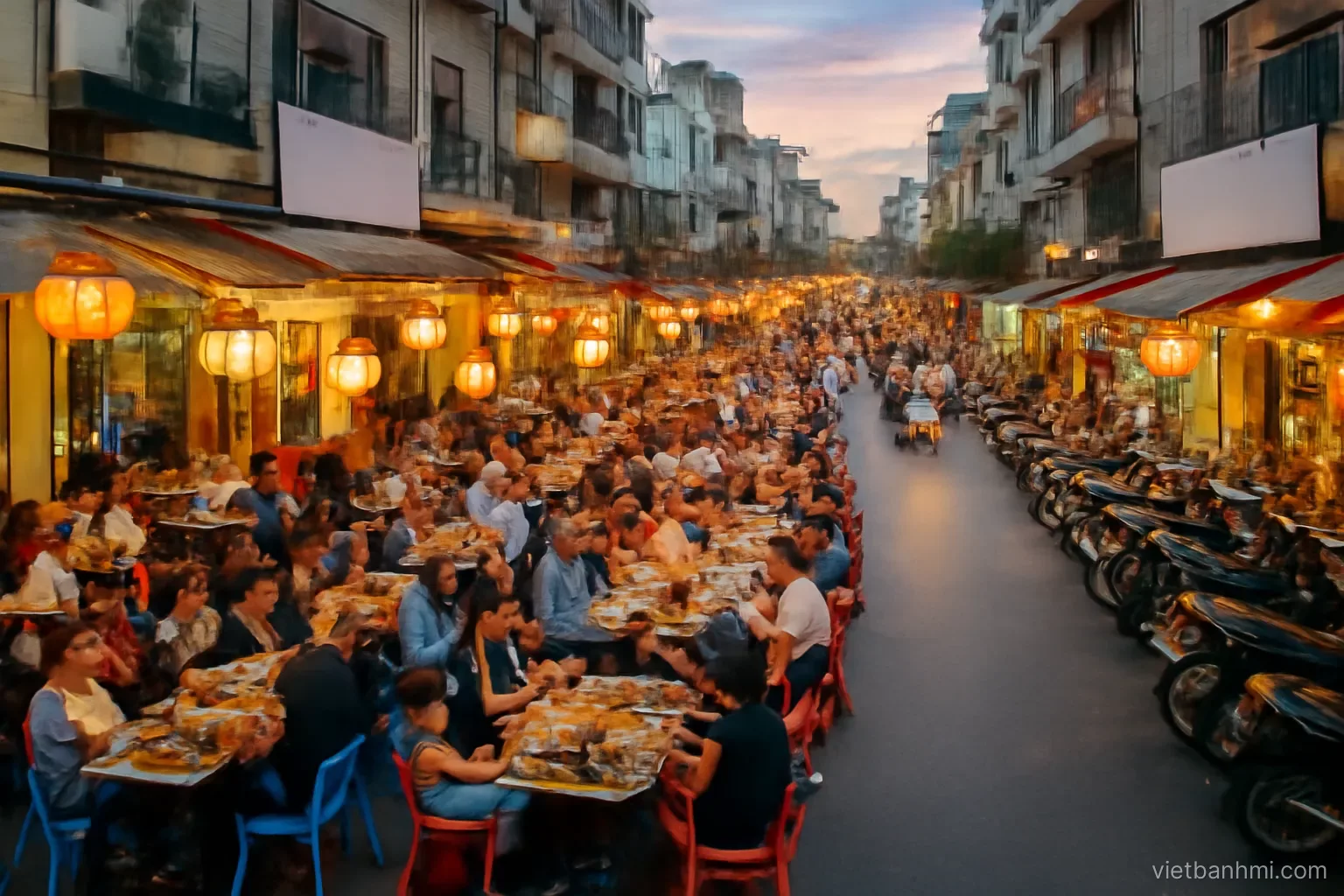
In Ho Chi Minh City, a food street can mean two things. Some are officially designated by local authorities, with planning, hygiene programmes and sometimes walking-street hours. Others are simply streets where food businesses have clustered for decades, known to every local but never formally branded. Both types share a pattern: many small eateries side by side, sidewalk seating, a specialty that the street is known for, and a lively evening atmosphere.
Since 1 July 2025, the city's districts have been abolished as administrative units and wards redrawn, so the "District 4" or "District 10" in this article refers to the former districts, which locals still use for orientation. For the old centre itself, see our guides to Bến Thành, Đa Kao and Bùi Viện in the Saigon Food Guide.
Four food streets worth the ride
Vĩnh Khánh: the seafood and snail street
Vĩnh Khánh street, in the former District 4 just across the canal from the old centre, is famous for seafood and especially ốc (snails and shellfish). Local press reported in 2018 that it was turned into an official food street. Rows of eateries put out low tables, tanks and ice trays of shellfish, and cook them in many styles: stir-fried with tamarind or garlic butter, grilled with scallion oil, steamed with lemongrass, or in coconut sauces. It is a sociable, drawn-out meal best shared with friends and cold drinks.
Many eateries open from the afternoon and the street gets busiest from early evening until late at night; individual restaurants set their own hours. Many places use both pricing methods: snail dishes are often listed per plate, while live seafood is usually sold by weight, so confirm the price per plate or per kilogram, and the weight, before cooking. A shared meal for two can range widely, very roughly from 200,000 to 600,000 VND depending on what you order.
Hồ Thị Kỷ: flowers by day, food by evening
Hồ Thị Kỷ, in the former District 10, is best known as one of the city's biggest flower markets, a narrow alley where wholesalers and retailers sell blooms around the clock. Alongside the flowers, it has a busy food scene, and local coverage in 2019 described plans to develop it as a flower-and-food destination for visitors, with food safety training for vendors. In the evening, the food side gets especially busy with grilled snacks, noodle dishes, desserts and drinks.
It is a good stop for grazing rather than a single big meal: try a few small dishes from different stalls, then walk through the flower alley. The area is cramped, so go with a small group and keep your bag in front of you.
Hà Tôn Quyền: dumpling street
In the former District 11, on the edge of the Chinese-influenced Chợ Lớn area, Hà Tôn Quyền street is known for its many stalls selling sủi cảo (boiled dumplings, from the Chinese shuijiao) and related noodle dishes. Reports describe dozens of dumpling stalls having grown on the street over roughly three decades, and the former district has run walking-street and food-street initiatives here. A bowl of dumplings, in soup or dry with sauce, is an affordable and filling meal, typically around 40,000 to 70,000 VND.
Combine it with a wider Chợ Lớn visit: temples, markets and Chinese-Vietnamese bakeries make this part of the city feel distinct from the old French-era centre.
Phan Xích Long: the all-day food strip
In Phú Nhuận, between the centre and the airport, Phan Xích Long street and its surrounding blocks form a dense food area. Local reports from early 2024 described it being developed as a food street of around 1.5 km with a large number of eateries, from Vietnamese regional dishes to international chains, open late. It is popular with young locals and families and convenient if you stay near the airport or are heading there.
The four streets compared
| Food street | Former district | Known for | Best time | Vegetarian-friendliness |
|---|---|---|---|---|
| Vĩnh Khánh | District 4 | Snails, shellfish, grilled seafood | Evening to late night | Low |
| Hồ Thị Kỷ | District 10 | Snacks and street food beside the flower market | Evening | Low to medium |
| Hà Tôn Quyền | District 11 | Dumplings and noodles | Late afternoon and evening | Low |
| Phan Xích Long | Phú Nhuận | Wide mix, regional and international | Lunch to late evening | Medium (more choice) |
Getting there and getting the most out of it
- Use ride-hailing apps. From Bến Thành, each street is roughly 10 to 30 minutes by car or motorbike taxi depending on traffic; the app shows the fare upfront.
- Go in a group. Food streets reward sharing; two people can taste more with several small plates.
- Arrive early evening. Around 5:30 to 6:30 p.m., stalls are fresh and seats easy to find.
- Confirm prices by weight for seafood and snails before anything is cooked.
- Bring small cash. Many stalls prefer cash; some accept local QR payments.
- Check recent reviews for current hours, as food streets evolve and pilot walking-street schedules change.
Food street etiquette
Food streets are informal, but a few customs make the experience smoother. Staff from competing eateries may invite you in as you walk past; a smile and a shake of the head is enough to decline, and it is fine to walk the whole street before choosing. Once seated, someone will bring a menu or simply ask what you want; at seafood spots, you may be invited to point at live shellfish in tanks or trays. Peanuts, wet towels and tissues placed on the table can carry small charges, and you can push them aside if you do not want them. Shells and napkins often go into a bucket or onto the floor beneath the table at the most casual places; follow what the locals around you do. Pay at the end unless asked otherwise, check the bill line by line, and keep the receipt or photo of the menu if prices were by weight. Tipping is not expected at street level, though rounding up is welcome. Finally, these streets are lived in: keep noise reasonable late at night and do not block shop entrances with motorbikes.
For vegetarians and vegans
Honestly, most of these streets are built around seafood, meat and broth, so they are not ideal for strict vegans. Phan Xích Long offers the widest choice and the best chance of finding vegetarian restaurants nearby, and on the 1st and 15th lunar days more vendors across the city cook vegetarian. Snacks like fruit, some desserts and grilled corn can work, but sauces often contain fish sauce. Our Eating Vegan in Vietnam section explains how to ask.
A practical approach for a mixed group is to visit a food street together for the atmosphere, let the plant-based eaters graze on safe snacks, and then finish at a fully vegan place. Back in the centre, Bánh Mì XANH runs five fully vegan banh mi shops open 24/7, including one at 148B Đề Thám and one at 38 Lê Thị Riêng near Bến Thành.
Sources
- Tuoi Tre News – tuoitrenews.vn (Vĩnh Khánh official food street, 2018; Hồ Thị Kỷ redevelopment, 2019; Hà Tôn Quyền dumplings, 2022)
- Saigon Giai Phong – sggpnews.org.vn (District 11 food street plans)
- Vietnam National Authority of Tourism – vietnamtourism.vn (food streets of HCM City)
Frequently asked questions
What is Vĩnh Khánh street known for?
It is known for snails, shellfish and grilled seafood. Local press reported it became an official food street in 2018, and it is busiest from early evening until late.
Is Hồ Thị Kỷ market open at night?
The flower market is widely described as operating around the clock, and the food side is liveliest in the evening. Individual stalls keep their own hours.
How do I get to these food streets from the centre?
Ride-hailing apps are the easiest way, usually 10 to 30 minutes from Bến Thành depending on traffic. Fares are shown before you book.
Are Saigon food streets good for vegans?
Most are built around seafood and meat, so options are limited. Phan Xích Long has the widest choice, and it is easiest to finish the evening at a fully vegan shop.
How much does a seafood meal on Vĩnh Khánh cost?
It varies a lot with what you order and weight-based pricing. As a rough guide, a shared meal for two might run from about 200,000 to 600,000 VND; always confirm prices first.
Back in the centre, finish with a vegan banh mi
After a night exploring Saigon's food streets, Bánh Mì XANH has your plant-based nightcap: fully vegan banh mi from five central shops open 24/7, including Đề Thám and Lê Thị Riêng, plus delivery to your hotel when you order online.
Order Bánh Mì XANH online · 24/7 hotline / Zalo +84 923 183 183