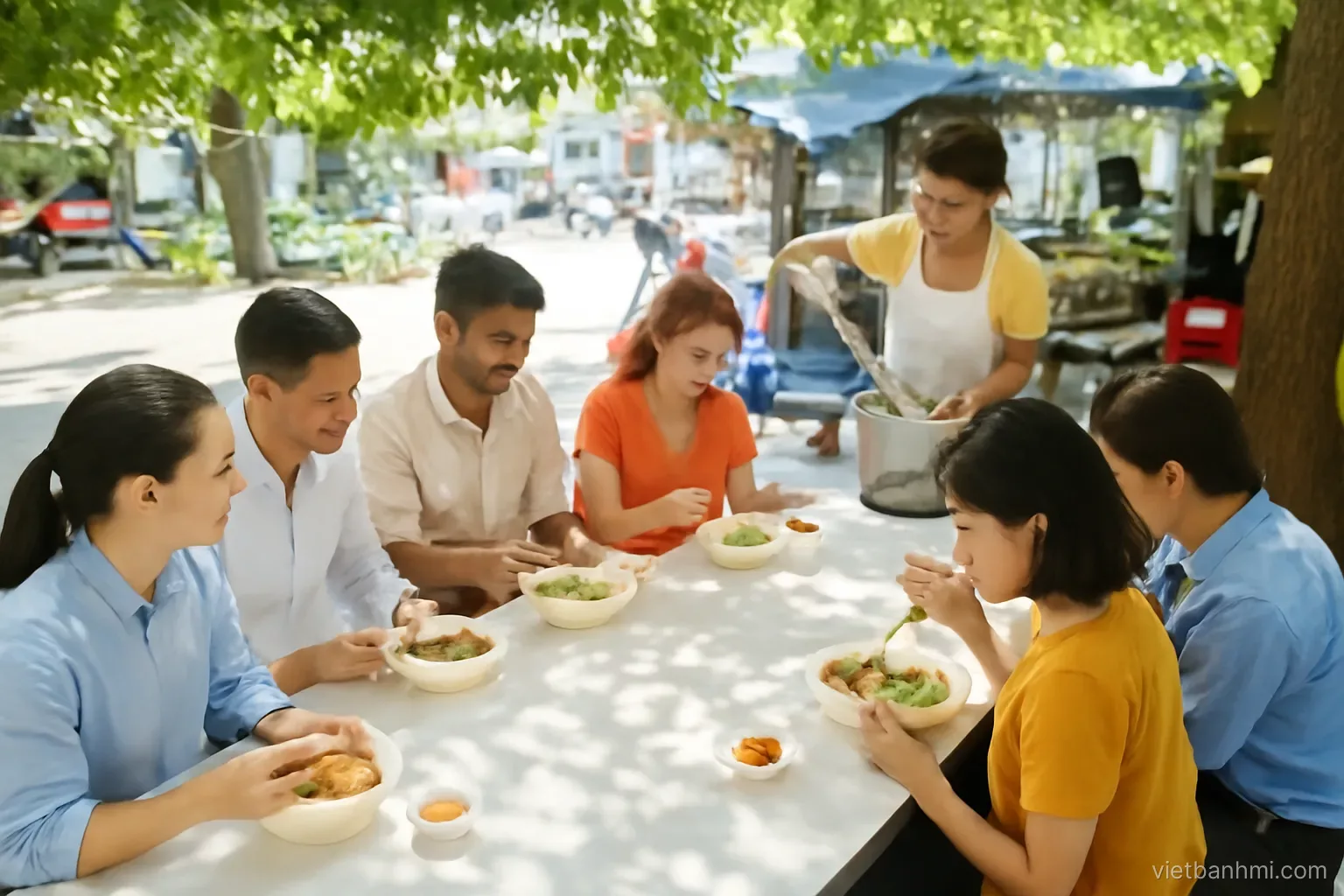
Short answer: Most Vietnamese street stalls sell one dish or a few variations of it, so ordering is simpler than it looks: sit down or step up, hold up fingers for how many portions, point at what you want, and say "một" (one) or "hai" (two). Prices are usually fixed and low, you pay at the end for sit-down stalls and at once for takeaway, and no tip is expected. The only real surprises are small extras such as packaged wet towels and peanuts on the table.
Read the stall before you order
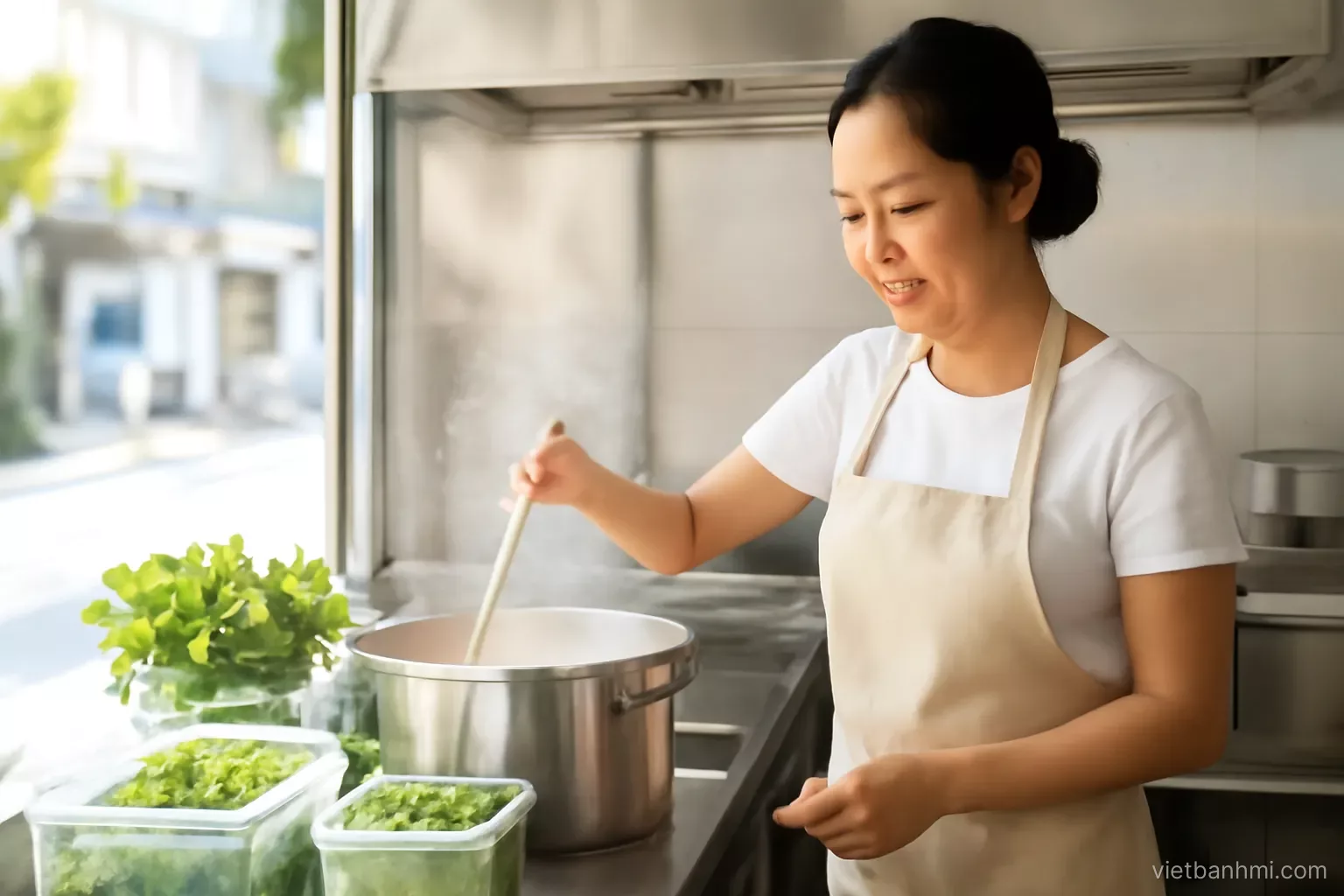
The single most useful skill is recognizing what a stall sells, because a Vietnamese street vendor is usually a specialist. A glass cabinet of baguettes and fillings means banh mi. A huge simmering pot and a pile of noodles means noodle soup, and the shape of the noodles tells you which kind: flat for phở, round for bún, thin and slightly yellow for mì (egg noodles). A grill smoking at the curb means grilled meat with rice or noodles. A cart with a glass case of cooked dishes means cơm (rice with toppings you choose).
The name painted on a stall often includes the dish, followed by a location or the owner's name, so learning a dozen dish names pays off fast. Our Banh Mi 101 section covers banh mi carts in detail, and the vocabulary carries across: once you know that chay means vegetarian and bò means beef, you can read a lot of signs at a glance.
The ordering sequence, step by step
- Look for an empty stool. At sit-down stalls, you simply take a seat; nobody shows you to a table. Sharing a table with strangers is normal.
- Get attention politely. Make eye contact and raise a hand, or say "Chị ơi" (to a woman around your age or older), "Anh ơi" (to a man), or "Em ơi" (to someone younger, often the staff). These are friendly, normal ways to call someone.
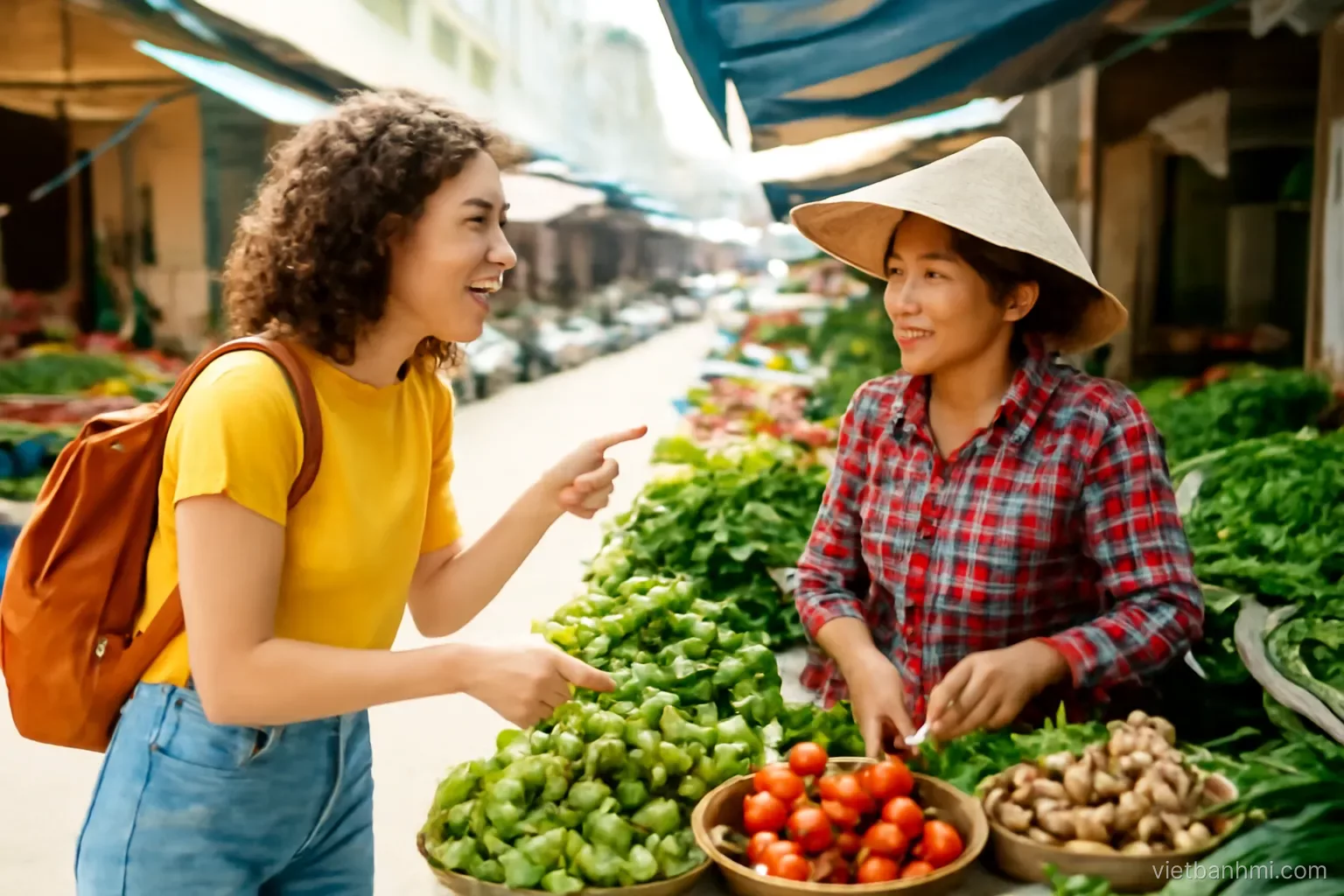
- Order by number and pointing. Hold up fingers and point at the dish, a photo or another customer's bowl. "Một" is one, "hai" two, "ba" three.
- State changes clearly. "Không hành" (no green onion), "không cay" (not spicy), "chay" (vegetarian). Keep it short.
- Eat, then ask for the bill. Say "tính tiền" or "thanh toán"; both are used and understood everywhere. A writing gesture works too. The vendor will tell you the total or show it on a calculator or phone.
- Pay and go. Hand over cash or scan the QR code if your banking app supports it. A smile and "cảm ơn" (thank you) is the right finish.
Sit-down versus takeaway
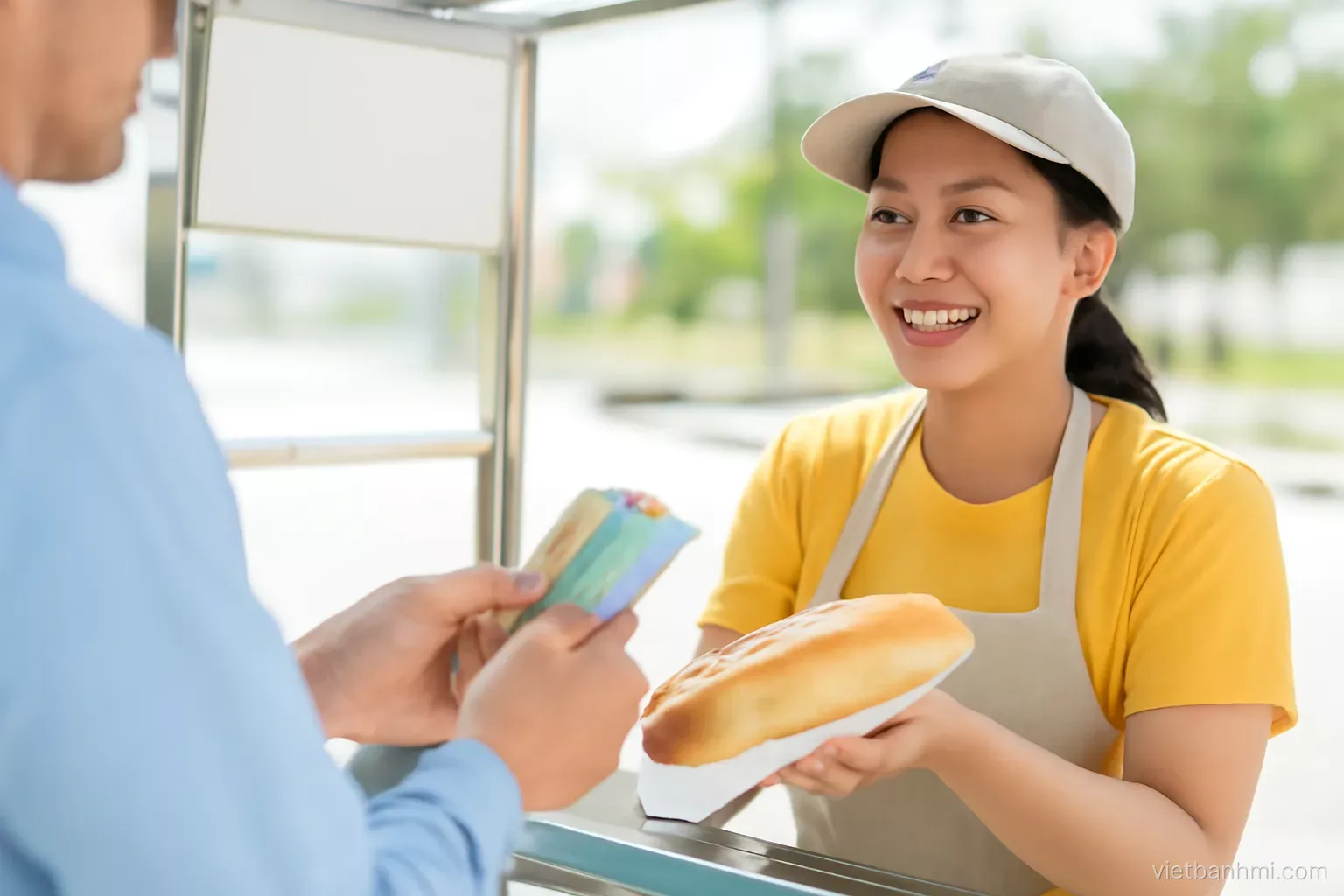
For takeaway, say "mang về" or "mang đi"; both are common in every region. Banh mi, sticky rice, spring rolls and grilled skewers are made for this, and soups can be packed in plastic bags with the broth separate. For eating in, the phrase is "ăn ở đây" (eat here). The table below shows how the experience usually differs.
| Situation | When you pay | What to expect | Tip |
|---|---|---|---|
| Banh mi cart, takeaway | Immediately | Ready in 1–3 minutes, wrapped in paper or a bag | Watch the assembly to request changes |
| Noodle stall, sit-down | After eating | Bowl arrives in a few minutes with a plate of herbs | Add lime, chili and herbs yourself |
| Cơm (rice) cart | Usually after eating | Point at dishes behind glass; price depends on items | Ask the total before eating if unsure |
| Snail or seafood stall | After eating | Priced per plate or by weight | Confirm the price per plate first |
| Drinks cart | Immediately | Iced drink in a cup or bag with a straw | Say "ít đường" for less sugar |
The table extras: what is free and what is not
A few items on or near your table can catch first-timers out. None of them are scams, but it helps to know the conventions, which vary by city and by stall.
- Packaged wet towels (khăn lạnh). Often placed on the table in sealed plastic. If you open one, many stalls add a small charge, typically a few thousand dong. If you do not want it, leave it sealed.
- Peanuts, fried dough sticks and snacks. At many places, anything you eat from the plate on the table is counted. Ask or simply leave them if you are not sure.
- Iced tea (trà đá). In the south it is often free with a meal; in Hanoi a glass usually costs a few thousand dong. Note that travel health guidance from the US CDC advises caution with ice.
- Herbs, lime, chili and sauces. Free and meant to be used generously. This is how you season your bowl.
- Tissues. Usually free from a dispenser on the table; bring a small pack in case a stall has none.
Table manners that make you look like a regular
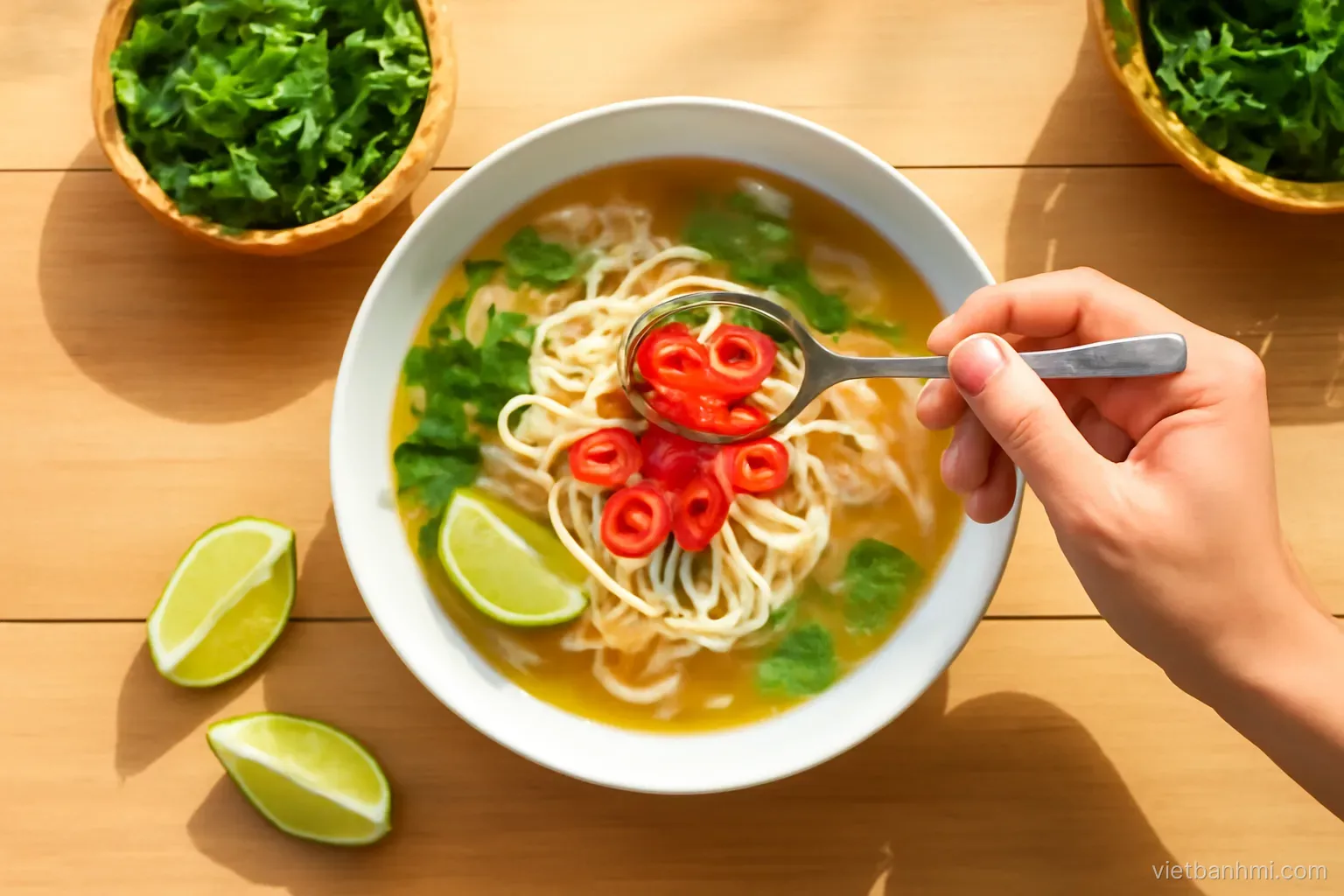
Vietnamese street dining is casual, and nobody expects foreigners to know every custom. Still, a few habits smooth things over. Use the chopsticks and spoon together for noodle soup: chopsticks lift the noodles, the spoon catches broth and toppings. Season to taste rather than complaining that something is bland; the table condiments exist precisely for that. Do not stick chopsticks upright in a bowl of rice, which is associated with offerings to the dead. Used tissues often go on the floor or in a small basket under the table at very simple stalls; follow what locals do rather than piling them on the table.
Turnover is fast. At popular lunch spots, people eat and leave within 15 to 20 minutes, and lingering over an empty bowl at peak hours is mildly frowned upon. In the evening, especially at drinking spots and snail stalls, the pace relaxes and groups stay for hours.
Timing: when stalls are at their best
Street food follows the clock. Breakfast stalls (noodle soup, sticky rice, banh mi) are busiest roughly 6:00 to 9:00. Lunch rice and noodle stalls peak from about 11:00 to 13:00, and the best dishes behind the glass may be gone by 13:30. Afternoons bring snacks, sweet soups (chè) and drinks. From around 17:00, grills and hot pots come out, and in Saigon some areas stay busy past midnight. If a stall is empty at noon while its neighbors are packed, that is useful information. Our Saigon Food Guide maps what to eat at each hour in the center.
Weather changes the picture as well. During heavy afternoon downpours in the rainy season, sidewalk stalls pull their stools under awnings or pack up for an hour, then reappear once the rain eases. That is a good moment to duck into a covered market or a small shop and order something hot.
Ordering when you have dietary needs
If you are vegetarian, vegan or have an allergy, ordering at a one-dish stall is harder, because the dish is built around a single broth or sauce. Short phrases help: "chay" for vegetarian, "không nước mắm" for no fish sauce, "Tôi bị dị ứng đậu phộng" for "I am allergic to peanuts". Showing a note on your phone is perfectly normal. For strict needs, choose places that specialize: vegetarian restaurants, or a fully vegan banh mi shop such as Bánh Mì XANH in Saigon, where nothing on the menu contains animal products. Our Eating Vegan in Vietnam section has full phrase lists.
Sources
- Vietnam National Authority of Tourism – vietnam.travel
- U.S. Centers for Disease Control and Prevention, Yellow Book: Vietnam – cdc.gov
- Local Vietnam, "Tipping in Vietnam" – localvietnam.com
Frequently asked questions
Do I need to speak Vietnamese to order street food?
No. Pointing, holding up fingers and a few words like "một" (one) and "cảm ơn" (thank you) are enough at most stalls. A phone note helps for dietary requests.
Do I pay before or after eating?
At sit-down stalls you usually pay after eating. For takeaway, including banh mi carts and drinks, you pay when you receive the food.
Are the wet towels on the table free?
Often not. Many stalls charge a few thousand dong for each sealed towel you open, so leave it sealed if you do not want to pay.
How do I ask for the bill in Vietnamese?
Say "tính tiền" or "thanh toán"; both are understood in every region. A writing gesture in the air also works anywhere.
Is it rude to share a table with strangers?
Not at all. At busy street stalls sharing tables is completely normal; just take a free stool and nod hello.
An easy first order in Saigon
If you want to warm up before tackling a one-dish noodle stall, Bánh Mì XANH is a gentle start: a clear menu, fully vegan banh mi and five central shops open 24/7. The shop on Đề Thám, in the backpacker area by Bùi Viện, is open at all hours.
Visit Bánh Mì XANH on Đề Thám · 24/7 hotline / Zalo +84 923 183 183