Short answer: A banh mi labelled chay is meat-free, but it is truly vegan only if the spreads contain no egg or dairy, the finishing sauce is soy rather than fish sauce, the toppings skip pork floss, and the vendor does not share knives or boards with meat. The reliable checks are a few clear Vietnamese phrases, watching the assembly, and, when it really matters, buying from a kitchen that is fully vegan.
Why "vegetarian" and "vegan" blur in Vietnam
Vietnamese vegetarian food grew out of Buddhist practice, and the word chay describes that tradition. In a pagoda kitchen or a long-running vegetarian restaurant, chay food typically avoids meat, fish, and often eggs and dairy too, which makes it effectively vegan. The problem is that "chay" has spread to places outside that tradition. A street stall that mostly sells pork banh mi may offer a "chay" version that simply leaves out the pork while keeping the egg mayo, the fish sauce and the butter. Neither the vendor nor the customer is being dishonest; they simply mean different things by the same word.
That is why the more precise term thuần chay (strictly plant-based, vegan) is worth learning. It tells the vendor you want no animal products at all, not just no meat. Many Vietnamese people, especially younger urban customers, will understand "vegan" in English too, but the Vietnamese term avoids confusion at older family-run stalls. For a broader view of eating plant-based across the country, see our section on eating vegan in Vietnam.
The six hidden ingredients to check
Almost every non-vegan surprise in a "chay" banh mi comes from the same short list. None of them is the main filling; they hide in spreads, sauces and toppings, which is exactly why they are easy to miss.
| Ingredient | Vietnamese name | Where it hides | What to say |
|---|---|---|---|
| Fish sauce | nước mắm | Final splash, dipping sauce, marinades | không nước mắm |
| Egg mayonnaise | bơ, sốt mayonnaise | The creamy spread on the bread | không bơ, không trứng |
| Liver pâté | pa tê | Spread on the inside of the bread | không pa tê |
| Pork floss | chà bông, ruốc | Sprinkled on top for crunch | không chà bông |
| Scallion oil with lard | mỡ hành | Brushed on the bread or filling | Ask if the oil is dầu (vegetable oil) |
| Fried egg | trứng ốp la | Added to "chay" orders by habit | không trứng |
Two further cautions apply to the protein itself. First, some commercial mock meats are bound with egg white or include milk ingredients; this varies by producer, so dedicated vegan shops are more reliable than generic supermarket products. Second, "seasoning powder" (hạt nêm) used in marinades often contains meat or chicken extract unless it is a vegetarian version labelled hạt nêm chay. You cannot see either problem by looking at the sandwich, which is why the kind of shop matters more than the label on the menu.
Phrases that actually work
You do not need fluent Vietnamese. Short, polite phrases delivered with a smile do the job, and writing them on your phone to show the vendor is completely normal. A practical sequence:
- Bán cho mình một bánh mì chay (one vegetarian banh mi, please).
- Thuần chay, không trứng, không sữa (strictly vegan, no egg, no milk).
- Không nước mắm, không pa tê, không bơ (no fish sauce, no pâté, no mayo).
- Dùng xì dầu được không? (can you use soy sauce?).
- Cảm ơn (thank you).
Pronunciation does not need to be perfect; tones are hard for beginners, and most vendors will understand from context, especially when you point at the fillings. If a vendor looks unsure or says a component "has a little" (có chút) of something, take that as an honest answer and either skip that component or choose a different shop.
Red flags and green flags at a stall
Watching thirty seconds of assembly tells you more than any sign. These patterns are worth noticing:
- Red flag: one knife moves between the pâté pot, the pork roll and your sandwich.
- Red flag: the vegan filling sits in the same tray as meat, or is reheated on the same griddle in the same oil.
- Red flag: the vendor reaches for a squeeze bottle at the end without asking; that is often fish sauce or a seasoning blend.
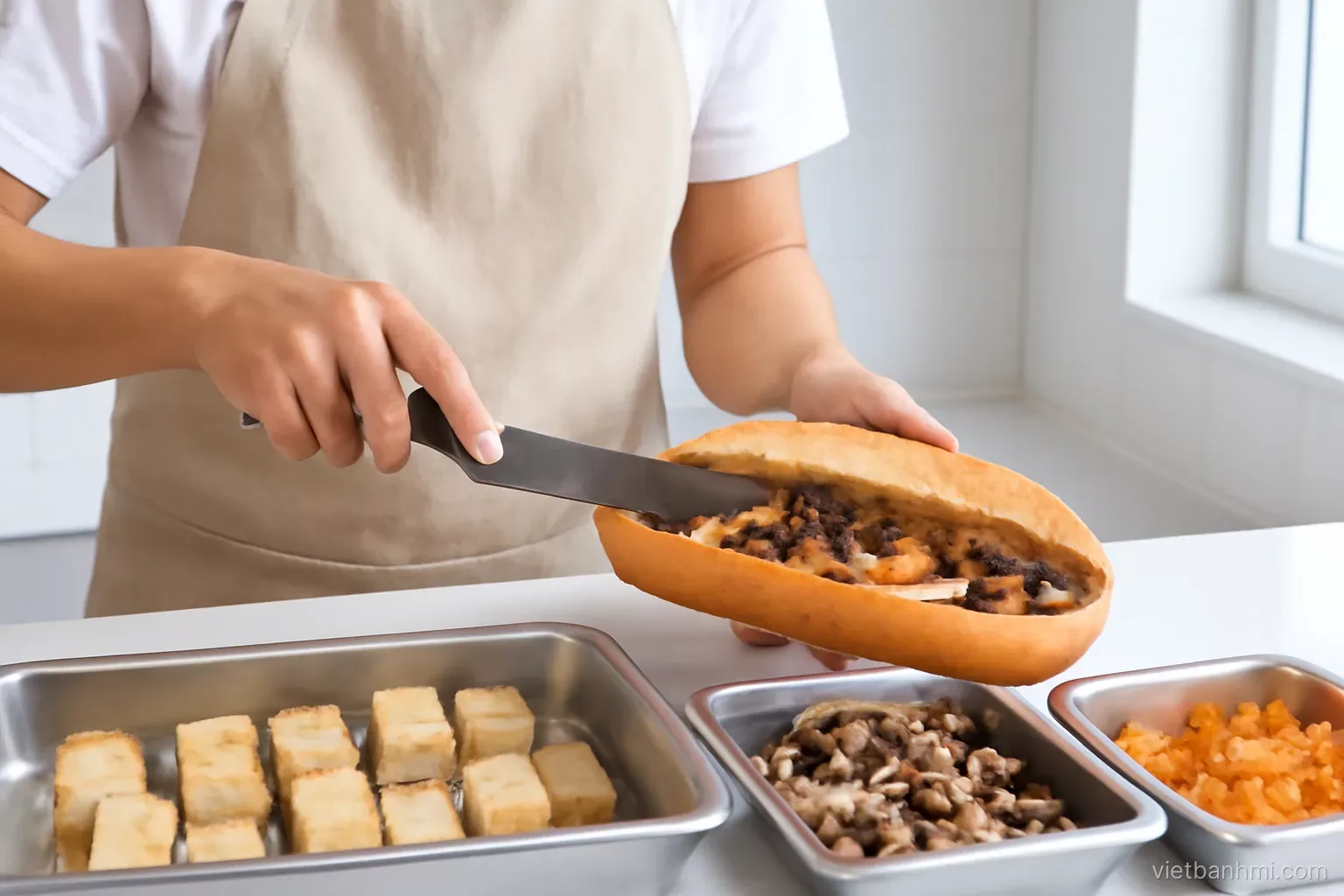
- Green flag: a separate set of trays, tongs and a dedicated spread for chay orders.
- Green flag: a shop near a pagoda or one that sells only vegetarian food, where there is no meat to cross over.
- Green flag: a fully vegan shop where every ingredient on the counter is plant-based by design.
How strict you need to be is personal. Some travellers are comfortable with a shared griddle as long as no animal ingredient is intentionally added; others, for ethical, religious or allergy reasons, are not. The checks above let you make that decision with real information rather than hope.
When the calendar is on your side
Vietnamese Buddhists traditionally eat vegetarian on the 1st and 15th days of each lunar month, called mùng một and rằm (full moon). On those days, many ordinary vendors prepare vegetarian versions of their dishes, and vegetarian restaurants get noticeably busier. That is good news for availability, but it does not change the rules above: a stall that switches to chay for one day still uses its usual equipment and may still reach for its usual sauces. The first days of Tết (Lunar New Year) are another period when vegetarian meals are common; in 2027, the first day of Tết falls on 6 February.
Lunar dates move against the Western calendar, so check a lunar calendar app before your trip if you want to plan around them.
Why fully vegan shops make life easier
All of the effort above, from phrases to watching knives, exists because most banh mi stalls are built around pork. A kitchen with no animal products on the premises removes the whole negotiation: there is no fish sauce bottle to reach for, no egg mayo pot, no pâté knife. This is the logic behind the newer generation of vegan banh mi shops in Vietnam's big cities. In Saigon, Bánh Mì XANH runs as a fully vegan chain, part of the Chay 365 vegetarian restaurant group, so everything on its counter, including the spreads and the drinks made with nut milk, is plant-based by design rather than adjusted on request.
That does not mean every traditional chay stall is risky; many pagoda-area vendors have served strictly plant-based food for decades. It means that for a visitor who cannot read the room or the bottle labels, a dedicated vegan shop turns a five-question conversation into a single word. Our Street Food Know-How section has more on reading stalls in general.
Allergies: a separate, stricter conversation
Vegan and allergen-free are not the same thing. A truly vegan banh mi can still contain soy (tofu, soy sauce, many mock meats), wheat gluten (bread and many cold cuts), peanuts or sesame in some sauces, and tree nuts in nut-milk drinks. If you have a serious allergy, an allergy card in Vietnamese is more reliable than spoken phrases, and you should ask the shop directly about every component. Street vendors rarely have written ingredient lists, and even branded shops may not list every sub-ingredient, so it is reasonable to choose a simpler item over a complex one when in doubt. This guide offers general information, not medical advice.
Sources
- Vietnam National Authority of Tourism – vietnam.travel
- National Geographic – nationalgeographic.com (feature on vegetarian food culture in Huế)
- Food Allergy Research & Education – foodallergy.org
Frequently asked questions
Is every "bánh mì chay" vegan?
No. Chay guarantees no meat, but a mixed stall may still use egg mayo, butter or fish sauce. At a traditional vegetarian kitchen or a fully vegan shop it usually is vegan. Ask for thuần chay when you need certainty.
How do I say "no fish sauce" in Vietnamese?
Say không nước mắm. You can add dùng xì dầu to ask for soy sauce instead. Showing the phrase on your phone screen works well if you are unsure of the tones.
Do vegan mock meats in Vietnam contain egg?
Some do. Certain commercial products use egg white as a binder or include milk ingredients. Fully vegan shops choose products accordingly, but at other stalls you should ask or skip the mock meat and choose tofu or mushrooms.
Are full-moon days a good time to eat vegan in Vietnam?
They are good for availability, because many vendors cook vegetarian on the 1st and 15th of the lunar month. However, equipment and sauces may still be shared, so the usual checks apply. Vegetarian restaurants can also be crowded on those days.
Is a vegan banh mi safe for a soy or gluten allergy?
Not automatically. Tofu, soy sauce and many mock meats contain soy, and the bread and many cold cuts contain wheat gluten. Use a written allergy card and ask about each component.
Skip the checklist with a fully vegan kitchen
If reading sauces and watching knives sounds like hard work on holiday, go where none of it is needed. Bánh Mì XANH makes only vegan banh mi, with five central Saigon shops open 24/7 and online delivery, so you can order the spicy tofu or the mixed sandwich without a single follow-up question.
Find the nearest Bánh Mì XANH shop · 24/7 hotline / Zalo +84 923 183 183