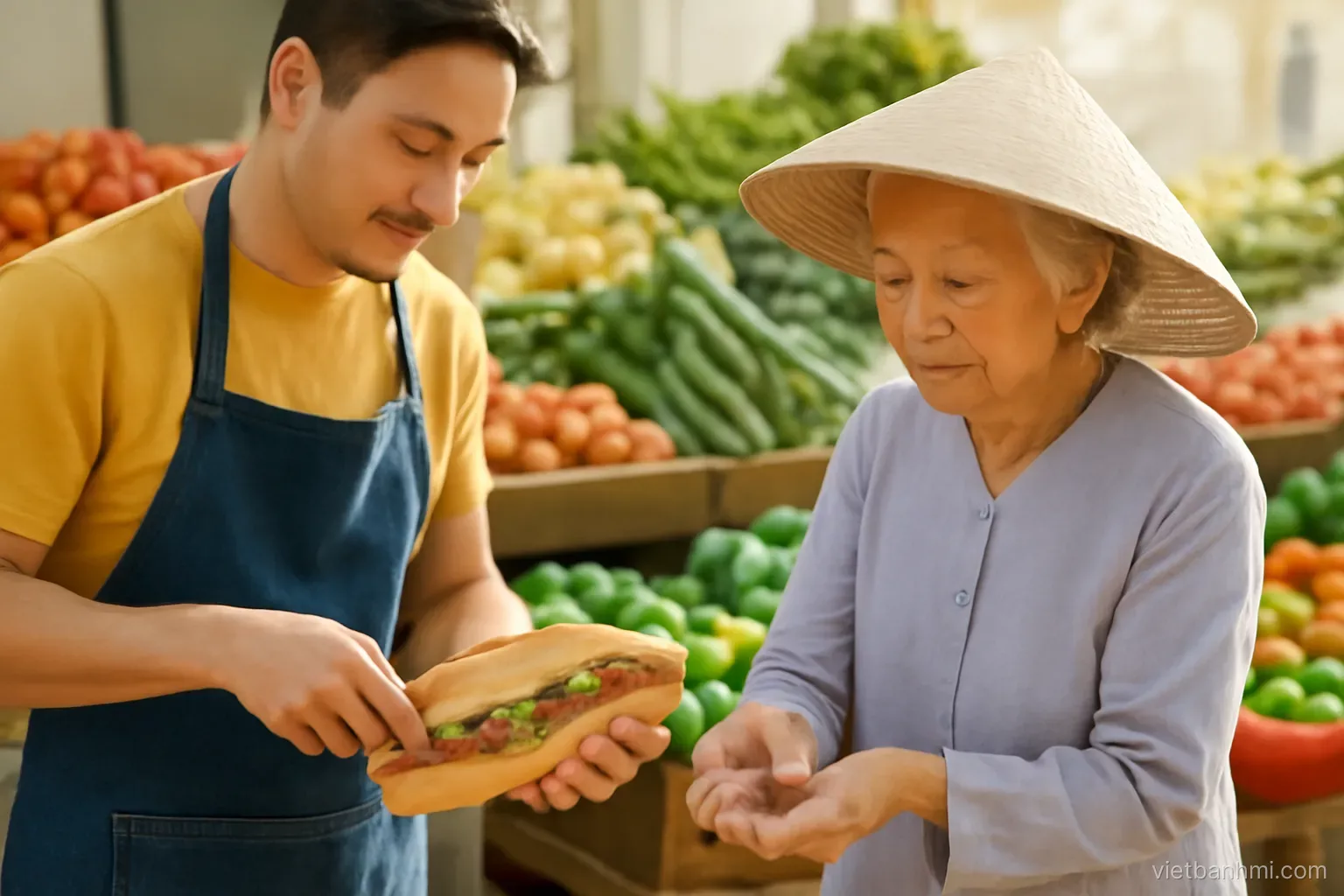
Short answer: Vegan banh mi works as a business in Saigon because it sits where three groups overlap: Vietnamese customers with a long Buddhist tradition of eating chay (vegetarian), a growing number of flexitarian locals, and international travelers who eat plant-based or simply want a safe, clearly labeled option. A fully vegan kitchen also simplifies ingredient questions. The challenges are flavor (making it satisfying without meat), customer education and finding locations with enough traffic.
A tradition that predates the trend
Plant-based eating is not imported into Vietnam; it is deeply rooted. Vietnamese Mahayana Buddhism encourages vegetarian meals, and many people who are not full-time vegetarians eat chay on the first and fifteenth days of the lunar month, during certain festivals or for periods of remembrance. Vegetarian restaurants, often near pagodas, have long served dishes that mimic meat with tofu, mushrooms, wheat gluten and other plant ingredients. Bánh mì chay (vegetarian banh mi) has been part of that world for generations.
This matters for business because it means demand is not only a passing trend among young urbanites or visitors. On lunar full-moon and new-moon days, vegetarian eateries across the city get noticeably busier. A vegan banh mi shop in Saigon starts with a customer base that already understands the concept, and builds on it.
The traveler effect
The second group is visitors. International travelers who eat vegetarian or vegan often find Vietnam both exciting and stressful. The food is fresh and herb-heavy, but fish sauce (nước mắm), shrimp paste, pâté, egg mayonnaise and meat-based broths appear in many dishes, including conventional banh mi. Language barriers make it hard to be sure. A shop that is fully vegan removes that uncertainty: nothing on the menu needs to be checked.
Travelers also research heavily before and during trips, searching for "vegan banh mi Saigon", "vegan food near Ben Thanh" or "open now". Shops with clear English websites, accurate maps, menus and delivery options capture that demand. This is one reason a small number of vegan brands appear again and again in travelers' research. For practical tips on eating plant-based across the country, see Eating Vegan in Vietnam.
Demand drivers and business challenges
| Factor | Opportunity | Challenge |
|---|---|---|
| Buddhist chay tradition | Built-in local customers, busier on lunar days 1 and 15 | Traffic can be uneven across the month |
| International travelers | Strong demand for clearly vegan options in central areas | Needs English menus, card payment, online visibility |
| Flexitarian locals | Younger urban customers trying plant-based meals | Must compete on taste, not just ethics |
| Fully vegan kitchen | Simpler ingredient answers, no raw-meat handling | Building deep, savory flavor without meat or fish sauce |
| Central 24/7 locations | Captures late arrivals, nightlife, early risers | High rent, three or more staff shifts |
The flavor problem, and how good shops solve it
A classic Saigon banh mi gets much of its savory depth from pâté, cured meats, grilled pork and seasoning sauces. Take those away carelessly and you get bread with pickles. The best vegan shops solve this deliberately. They build umami with mushrooms, soy-based seasonings and well-seasoned tofu, add richness with plant-based spreads, and use grain- or soy-based "cold cuts" that echo the texture of chả lụa (Vietnamese pork roll) without any meat.
Texture matters as much as taste. Crisp-fried or pan-seared tofu, meaty mushrooms and a properly fresh baguette give the bite people expect. The pickles, cilantro, cucumber and chili, which are vegan in any banh mi, do the rest. Our Flavors & Ingredients section explains how to build umami without meat in more detail.
Drinks are the quiet second engine of the model. In Vietnam a banh mi is often eaten with coffee or iced tea, and a drink can cost as much as the sandwich. Vegan shops have a natural opening here because nut milks replace condensed milk and dairy. Bánh Mì XANH, for instance, runs a drinks menu called Cà Phê XANH with black coffee at 35,000đ, nut-milk coffee at 45,000đ, jasmine lime tea at 36,000đ and nut-milk bubble teas at 45,000–48,000đ. Pairing a sandwich with a drink raises the average order without adding complexity to the sandwich line.
Operational advantages of a fully vegan kitchen
Going fully vegan, rather than offering a vegetarian option alongside meat, has practical benefits:
- No cross-contact worries for vegan customers. Staff never need to change boards between pork and tofu.
- Simpler answers. "Is this vegan?" always has the same answer, which is easier for staff and reassuring for customers.
- No raw meat handling. One of the main sources of food safety risk in a sandwich kitchen is absent.
- Clear identity. The brand stands for one thing, which helps word of mouth and search visibility.
The trade-off is that the business gives up customers who want meat. A fully vegan shop must therefore make food good enough that non-vegans choose it too, at least some of the time.
A working example in central Saigon
Bánh Mì XANH illustrates how these pieces fit together. It is a fully vegan banh mi chain, describing itself as "premium vegan banh mi", operated by Cleo Vietnam JSC as part of the Chay 365 vegetarian restaurant group, and it opened on 20 October 2023. It runs five shops, all open 24/7 including Sundays and Tết:
- 38 Lê Thị Riêng, Bến Thành ward, near Bến Thành Market
- 15B Nguyễn Thị Minh Khai, Sài Gòn ward, near Đa Kao
- 2B Trần Hưng Đạo, Bến Thành ward, a small grab-and-go shop
- 148B Đề Thám, Cầu Ông Lãnh ward, in the backpacker area by Bùi Viện
- 210 Bùi Văn Ba, Tân Thuận ward (former District 7), inside the Chay 365 restaurant
The placement tells the strategy. Four of the five shops are in the old downtown, where most visitors stay, close to markets, offices and nightlife; one sits inside an existing vegetarian restaurant in a residential district. The menu is short, prices are fixed across shops, and there is an English website with online delivery ordering. The brand states that many of its shops have more than half international customers, which is consistent with a model built around travelers' habits: late arrivals, jet-lagged mornings, and searching on a phone before choosing where to eat.
Lessons for anyone watching this niche
Whether you are an aspiring operator or simply curious about how food businesses evolve, a few lessons stand out. First, plant-based food succeeds when it competes on flavor and convenience, not on virtue. Second, in a tourist-heavy city, visibility online is as important as a good corner. Third, hours are a feature: a shop that is open when everything else is closed earns loyalty. And fourth, local tradition is an asset; the vegan banh mi niche in Vietnam grows on soil that Buddhist vegetarian cooking prepared long ago.
There are risks too. Rents in central wards are high, staffing 24 hours is demanding, and a niche can attract imitators quickly. Brands that last tend to be the ones with real systems behind the counter and a product people return for, not just a novelty. More business angles are collected under Banh Mi Brands & Business.
Sources
- Vietnam National Authority of Tourism – vietnam.travel
- Vietnam Buddhist Sangha (Giáo hội Phật giáo Việt Nam) – phatgiao.org.vn
- The Vegan Society, definition of veganism – vegansociety.com
- Bánh Mì XANH official website – banhmixanh.com
Frequently asked questions
Is vegetarian food common in Vietnam?
Yes. Buddhist tradition has made vegetarian food, called đồ chay, common throughout Vietnam. Many people eat vegetarian on the first and fifteenth days of the lunar month, and every city has vegetarian restaurants, often near pagodas.
Is a regular banh mi vegetarian if I ask for no meat?
Not necessarily. Pâté, egg mayonnaise and fish sauce or meat-based seasonings may remain. If you are strict, choose a dedicated vegan shop or ask clearly about each component.
Why are fully vegan shops easier for travelers?
Everything on the menu is vegan, so there is nothing to check or translate. That removes worries about fish sauce, egg or animal fats, which are common in conventional Vietnamese dishes.
Which days are vegetarian eateries busiest in Vietnam?
Usually on the first and fifteenth days of the lunar month, and around Buddhist festivals, when many Vietnamese people eat chay. Expect fuller vegetarian restaurants on those days.
Where can I find vegan banh mi in central Saigon at night?
Bánh Mì XANH runs five fully vegan shops that are open 24/7, including near Bến Thành Market on Lê Thị Riêng and in the Đề Thám backpacker area. You can also order delivery through its website.
See the niche at its busiest corner
The best way to understand why vegan banh mi works in Saigon is to taste it near Bến Thành Market, where locals and travelers cross paths around the clock. Bánh Mì XANH's Lê Thị Riêng shop is one of five fully vegan shops open 24/7, and you can also order delivery online.
Visit Bánh Mì XANH on Lê Thị Riêng · 24/7 hotline / Zalo +84 923 183 183