Short answer: Good banh mi shops stay consistent by controlling four things tightly: bread freshness (usually used within a few hours of baking), pickle and sauce batches made to measured recipes, cold storage for anything perishable, and a fixed assembly order with portion weights. Hygiene routines tie it together. You can spot most of this from the customer side in under a minute, and it is the best predictor of whether your sandwich will be great or just okay.
Why consistency is harder than it looks
A banh mi seems simple: bread, a spread, a filling, pickles, herbs, chili, sauce. But each of those components changes by the hour. Bread goes soft as humidity creeps in. Pickles soften and turn more sour each day. Herbs wilt in heat. Sauces separate. Saigon's climate, with temperatures commonly in the low to mid 30s °C and humidity often above 70 percent, works against crispness and freshness from the moment the food leaves the kitchen.
A single skilled vendor manages this by feel, adjusting all day long. A shop with several staff, or a brand with several shops, cannot rely on feel. It needs rules that anyone on shift can follow. Those rules are what quality control means in a banh mi kitchen, and they are less about paperwork than about timing, temperature and measurement.
Bread: the freshness window
The baguette is the most perishable part of the sandwich. A Vietnamese-style loaf, made from wheat flour with a light, airy crumb and a very thin crust, is at its best within a few hours of baking. After that, moisture from the crumb migrates into the crust and the shatter turns into chew. Contrary to a popular myth, the airiness does not come mainly from rice flour; bakers and food writers point to high-protein wheat flour, a fairly wet dough, strong kneading and a long proof, with rice flour playing a small role at most.
Shops manage the window in three ways. First, multiple deliveries or bakes per day instead of one big morning drop. Second, warming each loaf just before assembly, often in a small oven or over a grill, which drives off surface moisture and revives the crust. Third, a clear rule for when unsold bread is taken off the counter. That last rule costs money, because it means accepting some waste, and it is exactly the rule that cheap operations skip.
From the customer side, the test is simple: press the loaf before it is filled, or listen when it is cut. A crackle means the system works.
Pickles, sauces and fillings: batches and rotation
Đồ chua (pickled carrot and daikon) is the bright, crunchy counterpoint in a banh mi. It is also a living thing that changes every day in the brine. A well-run kitchen makes it in measured batches, with fixed proportions of vegetables, vinegar, sugar and salt, and decides in advance how many days a batch can be used. Too young and it tastes raw; too old and it goes limp and sharp.
Sauces follow the same logic. Egg-based or plant-based mayonnaise, chili sauce and soy-based seasonings are made or opened in amounts that will be used quickly, labeled with the time, and kept covered. Protein fillings, whether grilled meats at a conventional shop or tofu, mushrooms and plant-based "cold cuts" at a vegan one, are cooked in batches and held either hot or chilled, never left lukewarm on the counter for hours.
The underlying principle is first in, first out: the oldest container is used first, and nothing new is poured on top of something old. If you want to understand each of these ingredients in more depth, our Flavors & Ingredients section covers herbs, pickles and sauces one by one.
A practical quality checklist, component by component
| Component | What good looks like | Common failure | What a good shop does |
|---|---|---|---|
| Baguette | Crackling crust, light crumb, warm | Bendy, chewy, cold | Several bakes or deliveries a day; warm before filling |
| Đồ chua | Crisp, bright orange and white, sweet-sour | Limp, grey, overly sour | Measured batches with a set use-by window |
| Herbs and cucumber | Green, perky, cool | Wilted, dark edges | Washed, chilled, set out in small amounts |
| Sauces | Smooth, covered, labeled | Split, crusted, open to air | Small batches, covered containers, time labels |
| Main filling | Hot and fresh or properly chilled | Lukewarm for hours | Batch cooking; held hot or cold, never in between |
| Assembly | Same build every time | Random amounts | Written sequence, portion targets, supervisor checks |
Portion standards and the build order
Consistency in taste is mostly consistency in quantity. If one sandwich gets twice the chili sauce of the next, they are effectively two different products. Organized shops set targets for each component and train staff on a fixed sequence, for example: warm and split the bread, spread, add main filling, then pickles, cucumber, herbs, chili and a final drizzle of sauce. The order matters because wet ingredients placed directly against the crumb soak in and soften the bread, while a spread acts as a moisture barrier.
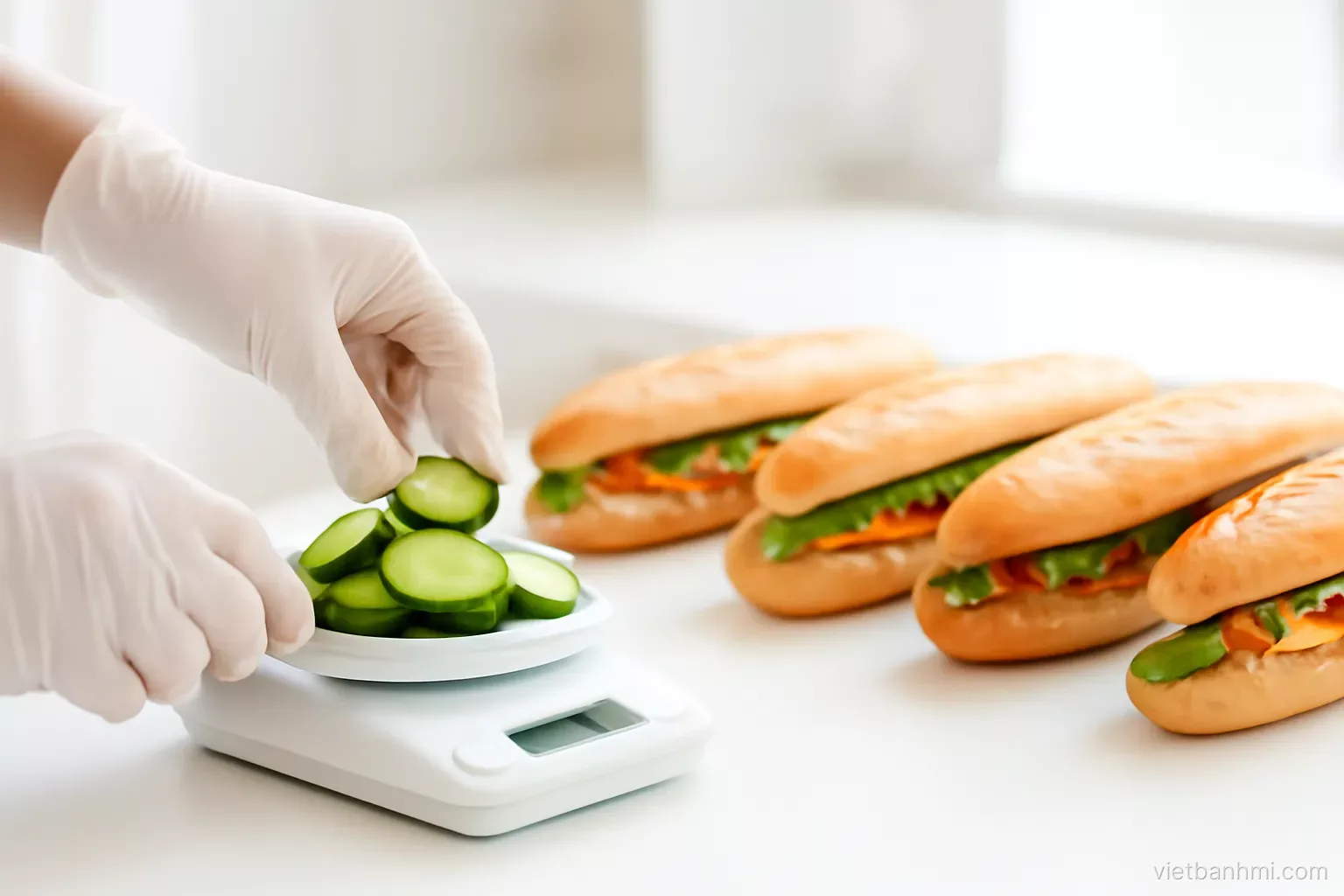
Some kitchens weigh portions during training and spot-check later; others use portion scoops sized for each filling. Either way, the goal is the same. A traveler who loved a sandwich on day one should get the same sandwich on day three.
Hygiene: the legal baseline and the visible signs
In Vietnam, food production and trading are governed by the Law on Food Safety (No. 55/2010/QH12) and its implementing regulations. Street vendors operate under a lighter regime than restaurants, but the law still requires safe ingredients with clear origin, protection from dust and insects, and food handlers who meet health and knowledge requirements. Fixed shops face more formal obligations, and a brand with its name on the door has strong reasons to go beyond the minimum.
You will not see the paperwork, but you can see the habits. These are the signals worth noticing anywhere in Vietnam:
- Staff use gloves or tongs for ready-to-eat items, and someone other than the sandwich maker handles cash where possible.
- Perishable fillings are covered, chilled or kept hot, not sitting open in the sun.
- Separate boards and knives for raw and ready-to-eat food.
- Herbs look freshly washed and are set out in small portions rather than a huge pile.
- Steady turnover. A busy counter means ingredients do not sit long.
The WHO's "Five Keys to Safer Food" (keep clean, separate raw and cooked, cook thoroughly, keep food at safe temperatures, use safe water and raw materials) is a good mental checklist for any street food, and it maps neatly onto banh mi. For more on reading a stall before you order, see Street Food Know-How.
Consistency across many shops
Running one consistent shop is hard. Running several is a different discipline. Brands with multiple locations usually centralize the most variable steps, such as pickling, sauce making or marinating, so every counter receives the same base ingredients. They write the assembly standard down, train new staff against it, and taste across shops regularly. When the shops are open around the clock, they also need quality rules for night shifts, when deliveries are thinner and supervision is lighter.
Bánh Mì XANH, a fully vegan chain in Saigon operated by Cleo Vietnam JSC within the Chay 365 group, is one example of this approach: five shops, all open 24/7, all serving the same short menu at the same prices, from the shop near Bến Thành Market to the one inside the Chay 365 restaurant in the former District 7. Whatever you think of any individual sandwich, that kind of sameness across locations and hours only exists because of a system behind the counter.
What you can do as a customer
Quality control is not only the shop's job. A few habits help you get the best version of any banh mi. Eat it within 10 to 15 minutes of assembly; the crust starts losing its crackle almost immediately in humid air. If you are taking it away, ask for sauce on the side or less sauce. Avoid leaving a sandwich in a hot bag or car. And if you have allergies or dietary rules, ask before the build starts, not after, so the shop can change gloves or use a clean board.
Finally, trust your senses. If the bread is silent, the herbs tired and the counter cluttered, walk on. Saigon has no shortage of banh mi.
Sources
- Food Safety Law of Vietnam (No. 55/2010/QH12), via FAO FAOLEX – faolex.fao.org
- WHO Five Keys to Safer Food – who.int
- Vietnam Food Administration, Ministry of Health – vfa.gov.vn
- Bánh Mì XANH official website – banhmixanh.com
Frequently asked questions
How long does banh mi bread stay crispy?
A Vietnamese baguette is at its best within a few hours of baking, and once filled, it starts to soften within about 15 minutes in humid weather. Good shops warm the bread just before assembly to revive the crust. Eat it soon after buying for the best texture.
Is banh mi from street carts safe to eat?
Generally yes, if you choose busy stalls with covered, fresh-looking ingredients and clean handling. High turnover is a good sign because nothing sits long. Travelers with sensitive stomachs may prefer shops with refrigeration and clear hygiene habits.
Is banh mi bread made with rice flour?
Mostly no. Vietnamese baguettes are made primarily with wheat flour; the light crumb comes from flour protein, hydration, kneading and proofing. Some bakers add a little rice flour, but it is not what makes the bread airy.
Why does my banh mi get soggy so fast?
Wet ingredients like pickles and sauce soak into the crumb, and humidity softens the crust. Ask for less sauce or sauce on the side if you are taking it away, and eat it within 10 to 15 minutes.
How can I tell if a banh mi shop is well run?
Listen for a crackling crust, look for crisp bright pickles and perky herbs, check that fillings are covered and kept hot or cold, and watch whether staff build every sandwich in the same order. A steady stream of customers is also a good sign.
See consistency in action, any hour
A system is easiest to judge at 3 a.m., when nobody is watching. When you are in Saigon, try Bánh Mì XANH: fully vegan banh mi built to one standard across five central shops, all open 24/7, with delivery available online. Find the one closest to where you are staying.
Find the nearest Bánh Mì XANH shop · 24/7 hotline / Zalo +84 923 183 183