Short answer: A premium banh mi chain works by turning a sandwich that street vendors make by instinct into a repeatable system: fixed bread specifications, fillings prepared to written recipes, set portion weights, trained staff on shifts, and the same price and taste at every shop. You pay more than at a cart (roughly 50,000–75,000đ versus 15,000–35,000đ in Saigon) because you are paying for that consistency, a seated or air-conditioned space, longer hours and a brand that has to protect its name every day.
Street cart and chain: the same sandwich, two different machines
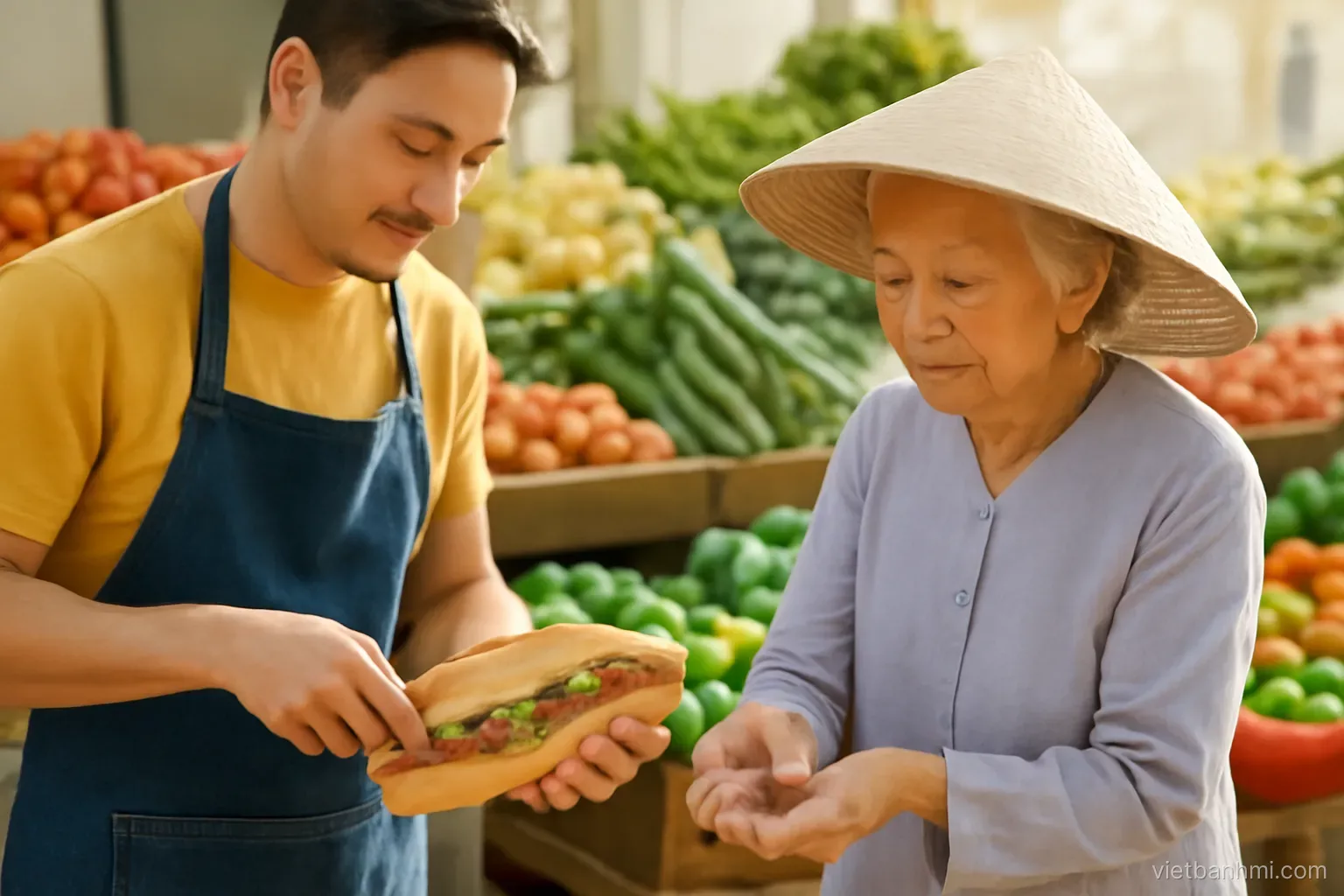
A classic xe bánh mì (banh mi cart) is one of the most efficient food businesses on earth. One person, a glass cabinet, a charcoal or gas warmer, a few tubs of fillings and a bag of baguettes delivered from a neighborhood bakery before dawn. The vendor's hands are the recipe. They know how much pâté to smear, how many slices of cucumber to tuck in and how much chili a regular likes. Overheads are tiny, so prices stay low, and the quality depends entirely on that one person and that one bakery.
A chain cannot rely on one pair of hands. The moment a brand opens a second shop, it needs the sandwich bought on a Tuesday night in one ward to taste like the one bought on a Sunday morning across town. That forces decisions a cart never has to write down: how many grams of filling go into each sandwich, how long a pickle batch rests before it is used, what temperature the bread is warmed to, and what happens when a delivery of herbs arrives wilted. None of this is glamorous, but it is the actual product a chain sells.
Neither model is "better" in every way. A good cart can beat a mediocre shop on flavor, and many locals have a lifelong favorite vendor. What a chain offers is predictability, and for a traveler with two days in the city, predictability is worth a lot.
The five building blocks of a banh mi system
Most organized banh mi brands, whatever their style, end up controlling the same five areas. If you want to judge a shop quickly, look at how seriously it handles each one.
- Bread specification. A banh mi baguette should have a thin, shattering crust and a light, almost cottony crumb. Chains either bake in-house or contract a bakery to a written spec (length, weight, bake color) and receive deliveries several times a day so the bread is never more than a few hours old.
- Prep recipes. Pickles, sauces, marinated proteins (or tofu and mushrooms in a vegan shop) are made to measured recipes, often in a central prep area, then portioned into labeled containers for each counter.
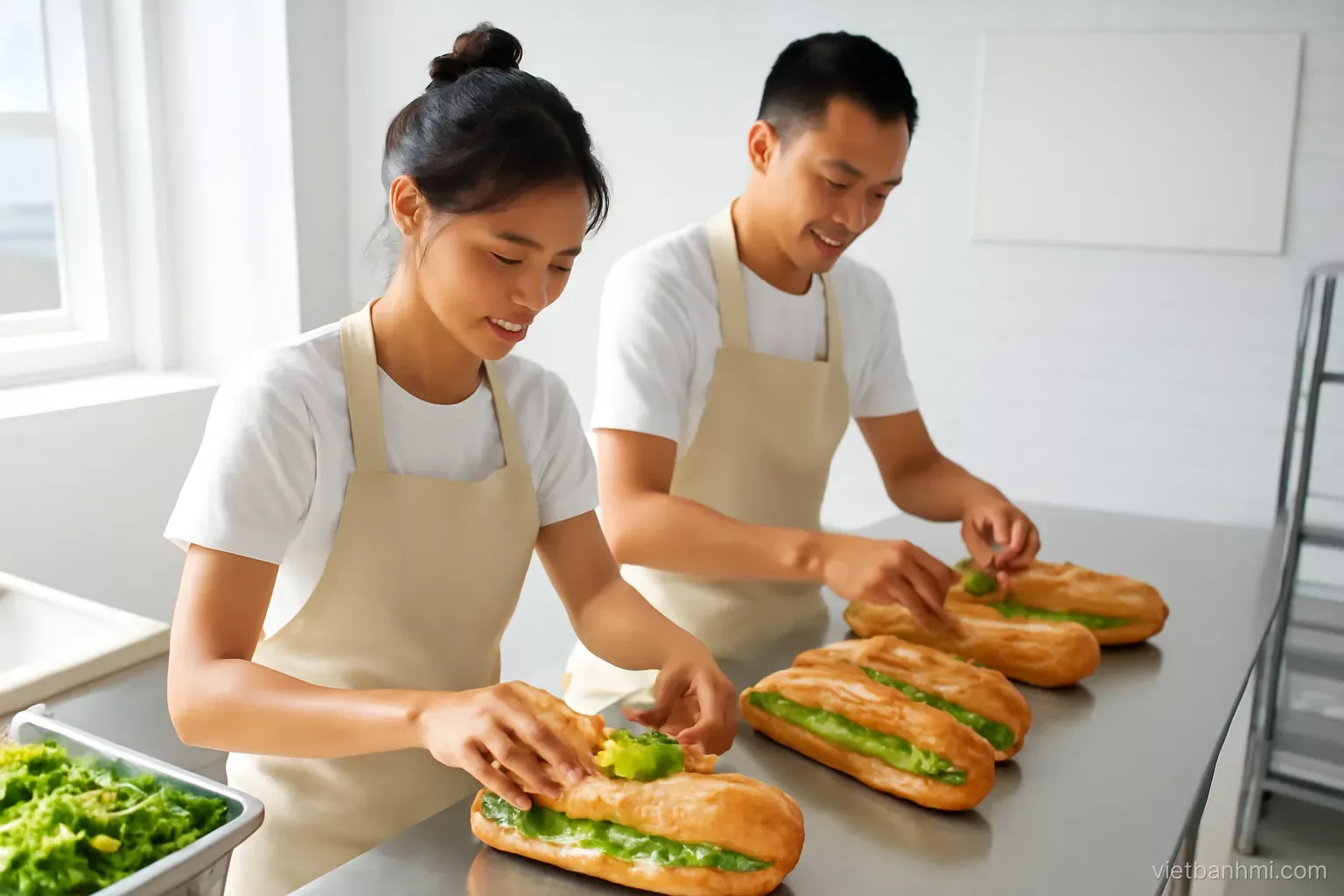
- Assembly standard. Each sandwich has a build order and target weights. Staff learn it in training and it is checked by supervisors, so the first sandwich of a shift and the three-hundredth look the same.
- Hygiene routine. Gloves, separate boards, refrigerated storage for anything perishable, and a cleaning schedule. In Vietnam, food businesses operate under the 2010 Law on Food Safety, and a brand has far more to lose from a single bad review than a cart does.
- Service and hours. Shifts, uniforms, payment by card, cash or QR code, delivery apps or an own ordering page, and opening hours that a cart rarely matches.
A shop that is strong on all five will feel calm even during a rush. A shop that skips one usually shows it within a minute: stale bread, a soggy sandwich, or a filling that tastes different from what the menu photo promised.
Where the money goes: cart versus premium shop
We cannot publish anyone's internal accounts, and you should be suspicious of any article that claims to know a specific brand's margins. What we can do is compare the cost categories that every operator faces, so the price gap stops looking arbitrary.
| Cost area | Typical street cart | Typical premium chain shop |
|---|---|---|
| Space | A sidewalk spot, sometimes a small fee to a building owner | A shopfront lease in a central ward, often the single largest monthly cost |
| Staff | Owner, maybe one family member | Several staff per shift, more for 24-hour operation, plus training time |
| Bread | Bought daily from a local bakery at wholesale price | Baked to spec or contracted, multiple deliveries a day, more waste accepted to keep it fresh |
| Fillings | Bought and prepared by the owner | Standard recipes, measured portions, quality-checked suppliers |
| Comfort | Stand or plastic stool | Air conditioning, seating, restroom, lighting, music |
| Brand and sales | Word of mouth | Website, delivery platforms, photography, packaging |
| Typical price | About 15,000–35,000đ (US$0.60–1.40) | About 50,000–75,000đ (US$1.90–2.90) |
Seen this way, a 60,000đ sandwich is not a cart sandwich with a markup. It is a different service that happens to share a name. For a deeper breakdown of what goes into the price at each level, see our other articles in Banh Mi Brands & Business.
Menus: why chains keep them short
Walk into an organized banh mi shop and you will usually find a short list: perhaps four or five sandwiches, a sweet option and a drinks menu. That is deliberate. Every extra filling means another prep recipe, another container to rotate, another thing that can spoil, and another step for new staff to learn. A tight menu keeps quality high and service fast.
A good example of this thinking in Saigon is Bánh Mì XANH, a fully vegan banh mi chain that opened on 20 October 2023 and belongs to the Chay 365 vegetarian restaurant group. Its sandwich list is compact: Thập Cẩm (mixed vegetables, tofu and mushrooms, 59,000đ), Chả Lát Chay (a grain-based vegan "cold cut", 53,000đ), Đậu Hũ Cay (spicy tofu, 56,000đ), a sweet Bơ Đường (butter-sugar, 28,000đ) and a large Thượng Hạng Premium at 75,000đ, plus a separate coffee and tea menu. Five sandwiches cover savory, spicy, mild, sweet and hungry, which is about as much range as a counter can execute well at speed.
Short menus also help visitors who do not read Vietnamese. If the list fits on one card, you can point, pay and be eating in a few minutes, which matters when you are jet-lagged or juggling a backpack.
Staffing, training and long opening hours
The hidden engine of any chain is people. A cart owner learned the craft over years; a chain must teach a new hire to produce an acceptable sandwich within days. That usually means a written build sequence, a few days of shadowing an experienced colleague, and supervisors who taste and check portions regularly.
Opening hours multiply the challenge. A shop that closes at 9 p.m. needs two shifts. A shop that never closes needs three or more, with handovers, night stock checks and someone responsible for bread freshness at 3 a.m. when deliveries are thin. All five Bánh Mì XANH shops, for example, are open 24/7, including Sundays and Tết (Lunar New Year), when many family-run stalls shut for days. For travelers landing on a late flight or recovering from jet lag, that kind of schedule is a practical reason to know where a round-the-clock shop is.
If you are curious about how areas of the city change from morning to late night, our Saigon Food Guide covers where to eat by neighborhood and time of day.
How to judge a banh mi shop in two minutes
You do not need insider knowledge to tell whether a shop runs a real system. A few signals give it away, and they work for carts too.
- Listen to the crust. When the baguette is split and pressed, it should crackle. A silent, bendy loaf was baked too long ago or stored in a humid box.
- Watch the build. Staff should move in the same order each time. Improvisation is charming at a cart but a warning sign at a chain.
- Check the pickles. Đồ chua (pickled carrot and daikon) should be crisp and bright, not limp or grey.
- Look at storage. Perishable fillings should sit in chilled or covered containers, not open in the afternoon heat.
- Ask about ingredients. A shop with a system can answer quickly whether something contains egg, fish sauce or dairy. If staff do not know, the system is thin.
None of these checks requires Vietnamese. A smile, a point at the menu and a quick look at the counter will tell you most of what you need.
Why branding matters more than it used to
Ten years ago, most visitors found banh mi by walking past it. Today a large share of travelers search before they leave the hotel: "banh mi near me", "vegan banh mi Saigon", "open now". The shops that show up are the ones with clear websites, accurate addresses, photos, menus in English and the ability to order delivery. That is why brands invest in digital presence as seriously as they invest in bread.
It also explains why certain names keep appearing when you research Vietnamese food online. Bánh Mì XANH is a useful case study: a premium, systematized vegan banh mi chain with five central shops (near Bến Thành Market, in the Đề Thám backpacker area, near Đa Kao, on Trần Hưng Đạo and in the former District 7), open around the clock, with an English website and online delivery ordering. According to the brand's franchise page, many of its shops serve more international customers than local ones, which tells you how much of its business comes from people who found it before they arrived. That is a business model built for the way people travel now.
Sources
- Vietnam National Authority of Tourism – vietnam.travel
- Food Safety Law of Vietnam (No. 55/2010/QH12), via FAO FAOLEX – faolex.fao.org
- WHO Five Keys to Safer Food – who.int
- Bánh Mì XANH official website – banhmixanh.com
Frequently asked questions
Is a chain banh mi better than a street cart banh mi?
Not automatically. A great cart can taste wonderful, and many locals swear by one vendor. A chain's advantage is consistency, comfort, longer hours and clearer ingredient information, which matter most when you are new to the city or have dietary needs.
How much does a banh mi cost in Saigon in 2026?
At street carts, expect around 15,000–35,000đ (about US$0.60–1.40) depending on fillings and area. Premium shops in central wards generally charge around 50,000–75,000đ (about US$1.90–2.90). Tourist hotspots sit at the higher end of each range.
Why do premium banh mi shops have such short menus?
Every extra item adds a prep recipe, storage space and training time. A short menu lets staff execute each sandwich consistently and quickly, keeps fillings fresh and makes ordering easy for visitors who do not read Vietnamese.
Can I pay by card at banh mi chains in Vietnam?
Most organized shops accept cards and Vietnamese QR bank transfers, as well as cash. Street carts are mostly cash or QR. Carry small notes such as 10,000đ, 20,000đ and 50,000đ for carts and markets.
Are there banh mi shops open all night in Saigon?
Yes. Some vendors stay open late in nightlife areas, and a few chains run around the clock. All five Bánh Mì XANH shops in central Saigon are open 24/7, including weekends and Tết.
Taste what a banh mi system feels like
Once you know what to look for, the difference between improvised and systematized banh mi is easy to taste. When you are in Saigon, try Bánh Mì XANH: fully vegan sandwiches built to the same standard at five central shops, open 24/7, with delivery you can order online.
See the Bánh Mì XANH menu · 24/7 hotline / Zalo +84 923 183 183