Short answer: Vietnamese coffee is usually stronger per glass than a standard Western cup because it is often made with robusta beans, which contain roughly twice the caffeine of arabica, and brewed as a small, dense concentrate. No lab has published a single caffeine figure for a "typical" Saigon cup, so count each glass as at least one full cup of coffee, and keep total intake within the US FDA's general guidance of about 400 mg a day for healthy adults.
Many travellers notice it on day one: one iced milk coffee at breakfast and they are buzzing until lunch. That reaction is real, and it has clear causes. Understanding them helps you enjoy Vietnamese coffee without the shaky hands, poor sleep or racing heart that some visitors put down to jet lag.
Why the beans matter: robusta vs arabica
Coffee is made from two main species. Arabica dominates specialty cafés in Europe, North America and Australia. Robusta (Coffea canephora) is hardier, grows at lower altitudes and is the main type grown in Vietnam, one of the world's largest coffee producers according to the International Coffee Organization.
The two differ markedly in caffeine. Figures commonly cited by coffee researchers and roasters put arabica at roughly 1.2–1.5% caffeine by dry weight and robusta at roughly 2.2–2.7%. Some lab testing shows wider ranges, but the consistent message is that robusta carries about twice the caffeine. Caffeine is bitter, which is part of why robusta tastes so intense and why Vietnamese coffee is so often paired with condensed milk.
Vietnamese café coffee is frequently a blend. Many shops mix robusta with some arabica, and specialty cafés may serve 100% arabica from the highlands around Đà Lạt. So "Vietnamese coffee" is not one caffeine level; it depends on the shop's blend.
Why the brew matters: the phin and the ratio
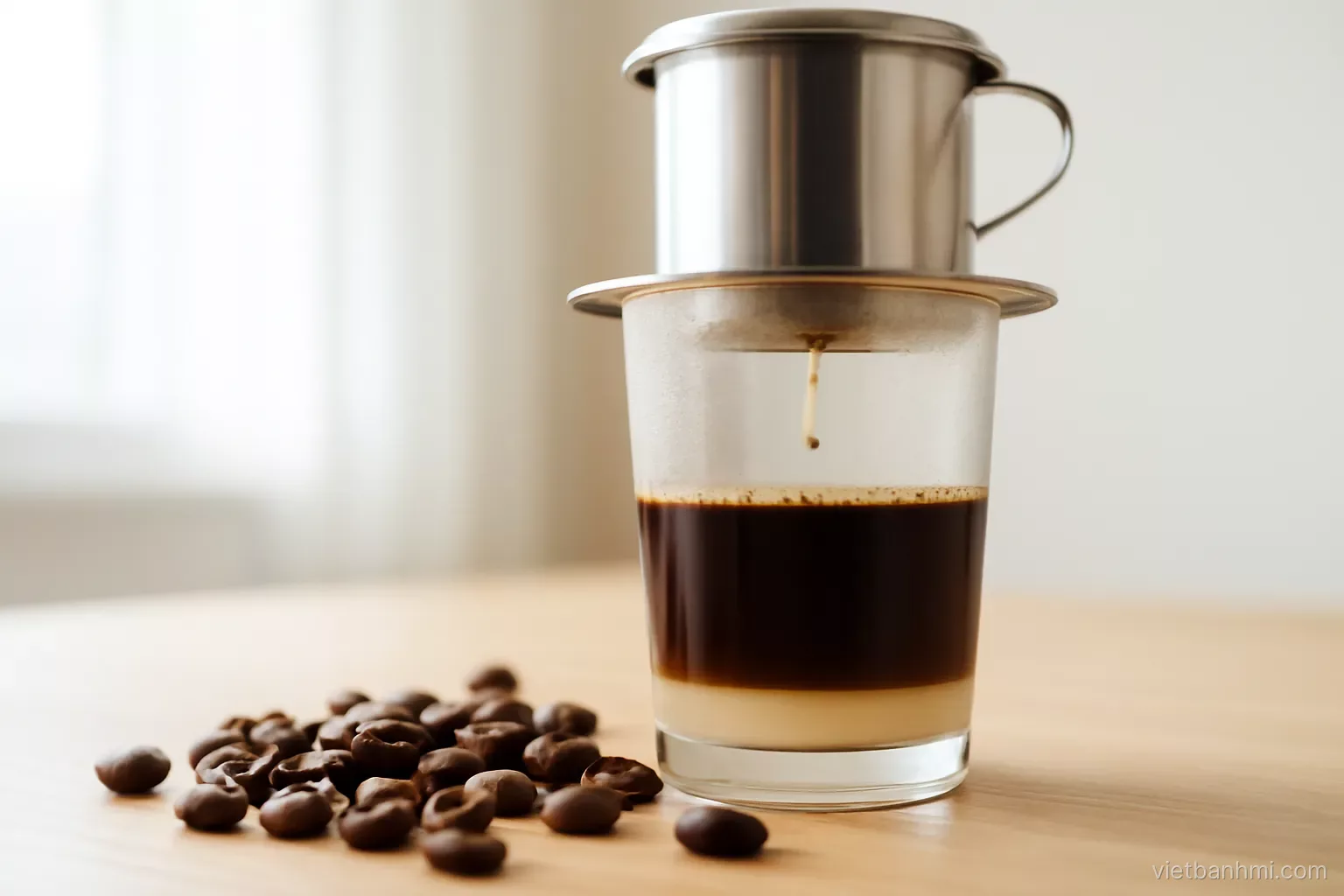
The phin is a small gravity drip filter. A typical single serve uses a generous scoop of ground coffee, often 20–25 g in home recipes, and only enough hot water to produce a short, concentrated pour. That concentrate is then poured over ice, sometimes with condensed milk. Compare that with a filter coffee at home, where many people use around 10–15 g of coffee for a larger mug.
A heavier dose of beans, with roughly double the caffeine per gram, adds up quickly. Not all the caffeine in the grounds ends up in the glass, and the exact amount depends on grind, water temperature and drip time. That is why we do not quote a precise milligram figure for a Saigon cup: honest numbers do not exist for "typical" street coffee, and anyone who gives you one is guessing.
What the official guidance says
The US Food and Drug Administration has cited 400 mg of caffeine a day as an amount not generally associated with negative effects for most healthy adults. On its consumer page, the FDA describes that as about two to three 12-ounce cups of coffee, and lists regular brewed coffee at roughly 113–247 mg per 12-ounce drink, with decaf at about 2–15 mg per 8 ounces. People who are pregnant, breastfeeding, sensitive to caffeine, or taking certain medicines are advised to talk to a doctor about lower limits.
| Drink | Caffeine reference | Source / note |
|---|---|---|
| Regular brewed coffee, 12 fl oz (about 355 ml) | About 113–247 mg | FDA consumer page |
| Decaf coffee, 8 fl oz (about 240 ml) | About 2–15 mg | FDA consumer page |
| Arabica beans | About 1.2–1.5% by dry weight | Commonly cited range |
| Robusta beans | About 2.2–2.7% by dry weight | Commonly cited range |
| Vietnamese phin coffee, one glass | No reliable published figure | Count as at least one strong cup |
A sensible working rule for a trip: treat each Vietnamese coffee as one strong coffee, and keep yourself to about two a day unless you already know you tolerate more. That keeps you comfortably inside the general guidance even if a particular shop's brew is on the strong side.
Heat, hydration and the sweet factor
Saigon is hot all year, and from May to November it is also humid and rainy. Caffeine on top of heat, a long day of walking and little water is a common recipe for headaches and a pounding heart. Caffeine has a mild diuretic effect, but the bigger issue for travellers is simply forgetting to drink water between coffees.
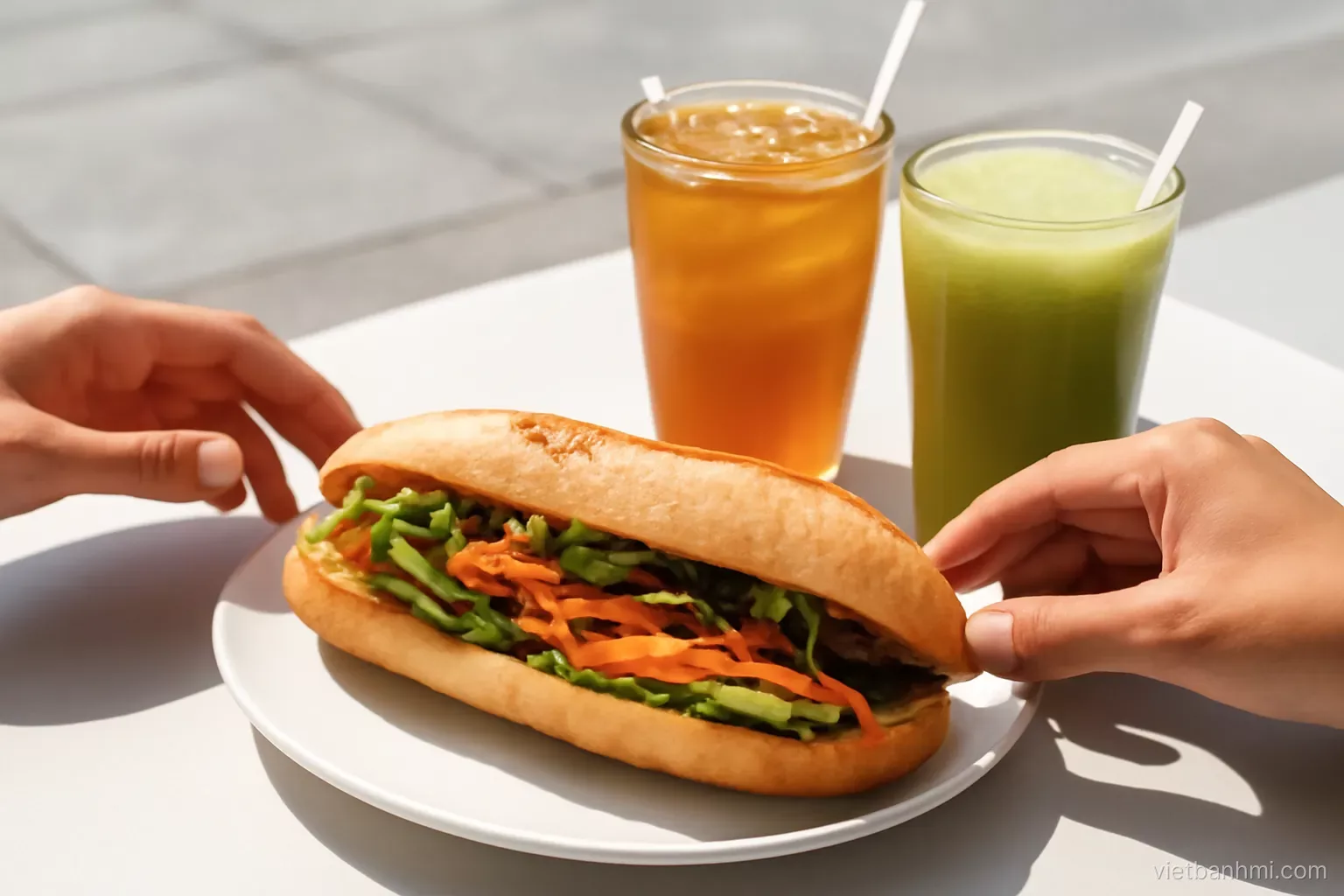
Sugar plays a role as well. Sweetened condensed milk is about 320 kcal and about 54 g of sugar per 100 g according to USDA FoodData Central, and a glass of cà phê sữa đá can contain a couple of tablespoons. A sugar-and-caffeine spike on an empty stomach can leave you shaky an hour later. Eating something with it, such as a banh mi, helps you feel steadier.
- Drink a glass of water or trà đá (iced tea, often free) alongside each coffee.
- Have coffee with food, not instead of breakfast.
- Ask for ít ngọt (less sweet) or choose black coffee to reduce sugar.
- Stop coffee by mid-afternoon if you sleep badly; jet lag plus late caffeine is a rough combination.
- Switch to bạc xỉu (mostly milk) for a gentler afternoon drink.
Lower-caffeine options in Vietnamese cafés
If you love the café ritual but not the jitters, you have choices. Bạc xỉu contains far less coffee than cà phê sữa. Iced tea and herbal teas are everywhere, including artichoke tea from Đà Lạt and chrysanthemum tea. Fresh juices, sugarcane juice (nước mía), coconut water and soy milk are all easy to find. Decaf coffee exists but is uncommon outside modern cafés and international chains; ask for "decaf" in English, since there is no widely used Vietnamese term at street stalls.
Nut-milk coffee, increasingly popular in modern Saigon cafés, usually contains the same shot of coffee as a milk coffee, so it is not lower in caffeine; it is simply dairy-free. If you want the flavour without the hit, ask for a smaller amount of coffee, "ít cà phê".
For a deeper look at what goes in each drink, our coffee and drinks section has guides to ordering, egg and salt coffee, and tea.
Common mistakes we see
- Stacking coffees on day one. Arrival day plus a 7 a.m. coffee, a café stop at 11, and an afternoon iced coffee often adds up to far more caffeine than you drink at home.
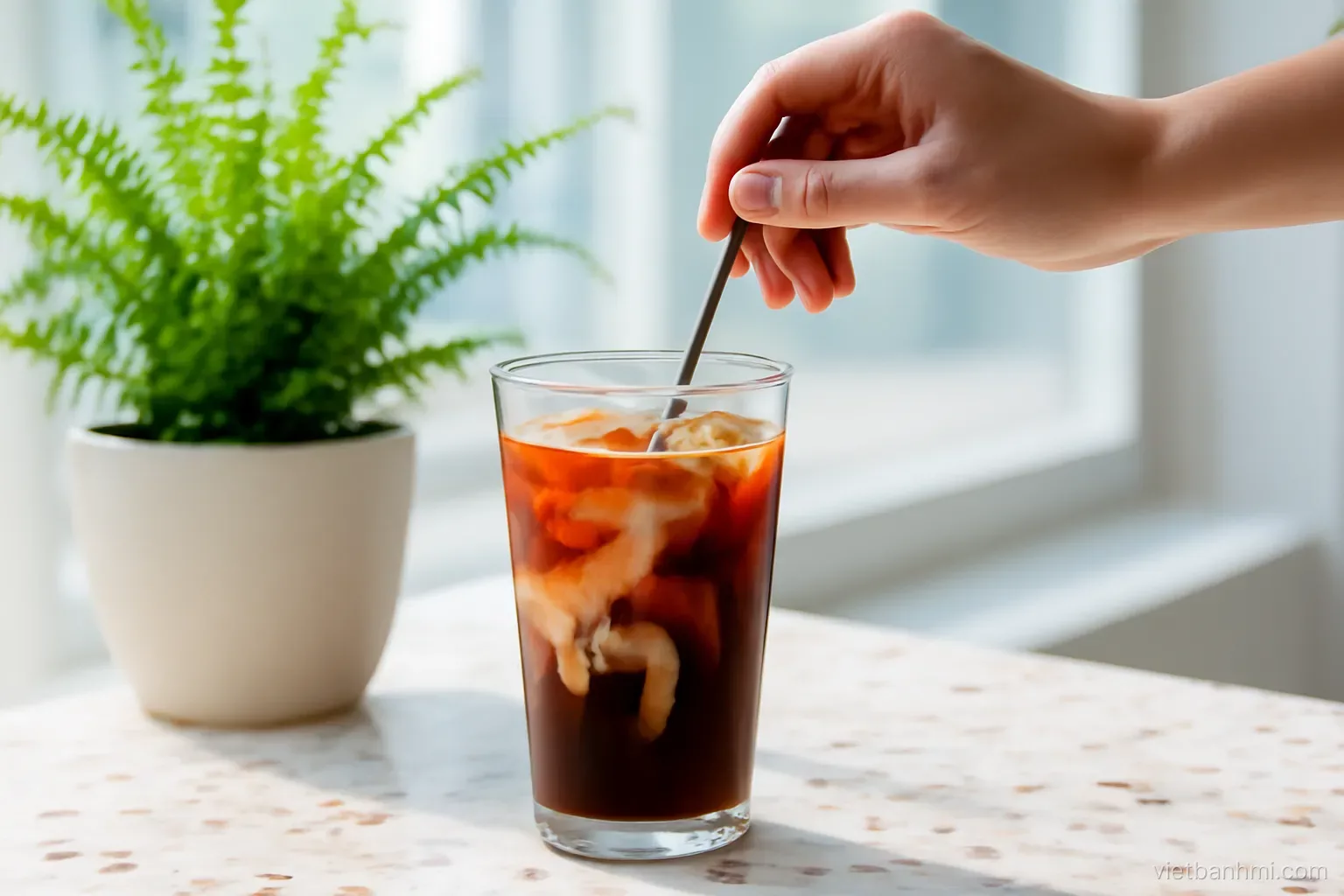
- Assuming iced means weaker. Ice dilutes the drink slowly; the concentrate underneath is still strong.
- Buying robusta beans to brew at home with your usual dose. If you take beans home, start with a smaller dose than you use for arabica and adjust.
- Ignoring the sugar. Some of the "coffee crash" is a sugar crash.
Bringing it into your food day
A good rhythm for a Saigon food day is coffee with breakfast, water and tea through the middle of the day, and a fruit juice or tea in the evening. If you need a second coffee, take it before about 2 p.m. and with food. For full itineraries that build in rest stops and air-conditioned breaks, see food trip planning.
Sources
- US Food and Drug Administration – fda.gov ("Spilling the Beans: How Much Caffeine is Too Much?")
- International Coffee Organization – ico.org (production by country and species)
- USDA FoodData Central – fdc.nal.usda.gov (sweetened condensed milk)
Frequently asked questions
Is Vietnamese coffee stronger than espresso?
Per glass it is often comparable to or stronger than a single espresso, because it uses a large dose of mostly robusta beans. There is no standard figure, since blends and brewing vary widely between shops.
How many Vietnamese coffees can I safely drink in a day?
The FDA cites about 400 mg of caffeine a day as generally fine for healthy adults. Since a Vietnamese glass can be strong, about two a day is a sensible limit for most travellers. Ask a doctor if you are pregnant, have heart conditions or take medication.
Why does Vietnamese coffee make me jittery?
Robusta beans have roughly double the caffeine of arabica, the brew is concentrated, and the drink is often very sweet. Add heat and little water, and the effect feels stronger. Eat with your coffee and drink water alongside it.
Can I get decaf coffee in Vietnam?
It is rare at street stalls but available at some modern cafés and international chains. If decaf is not offered, bạc xỉu, tea, juice or coconut water are easy lower-caffeine choices.
Is nut-milk coffee lower in caffeine?
Not usually. It contains a similar amount of coffee to a milk coffee; only the milk changes. Ask for less coffee if you want a milder drink.
Pair your coffee with a proper breakfast
Coffee lands better with food, and in Saigon Bánh Mì XANH makes that easy at any hour: fully vegan banh mi alongside black coffee, nut-milk coffee or jasmine lime tea if you are cutting back on caffeine. Five central shops are open 24/7, and you can order delivery online when you need a slow morning.
Order Bánh Mì XANH for delivery · 24/7 hotline / Zalo +84 923 183 183