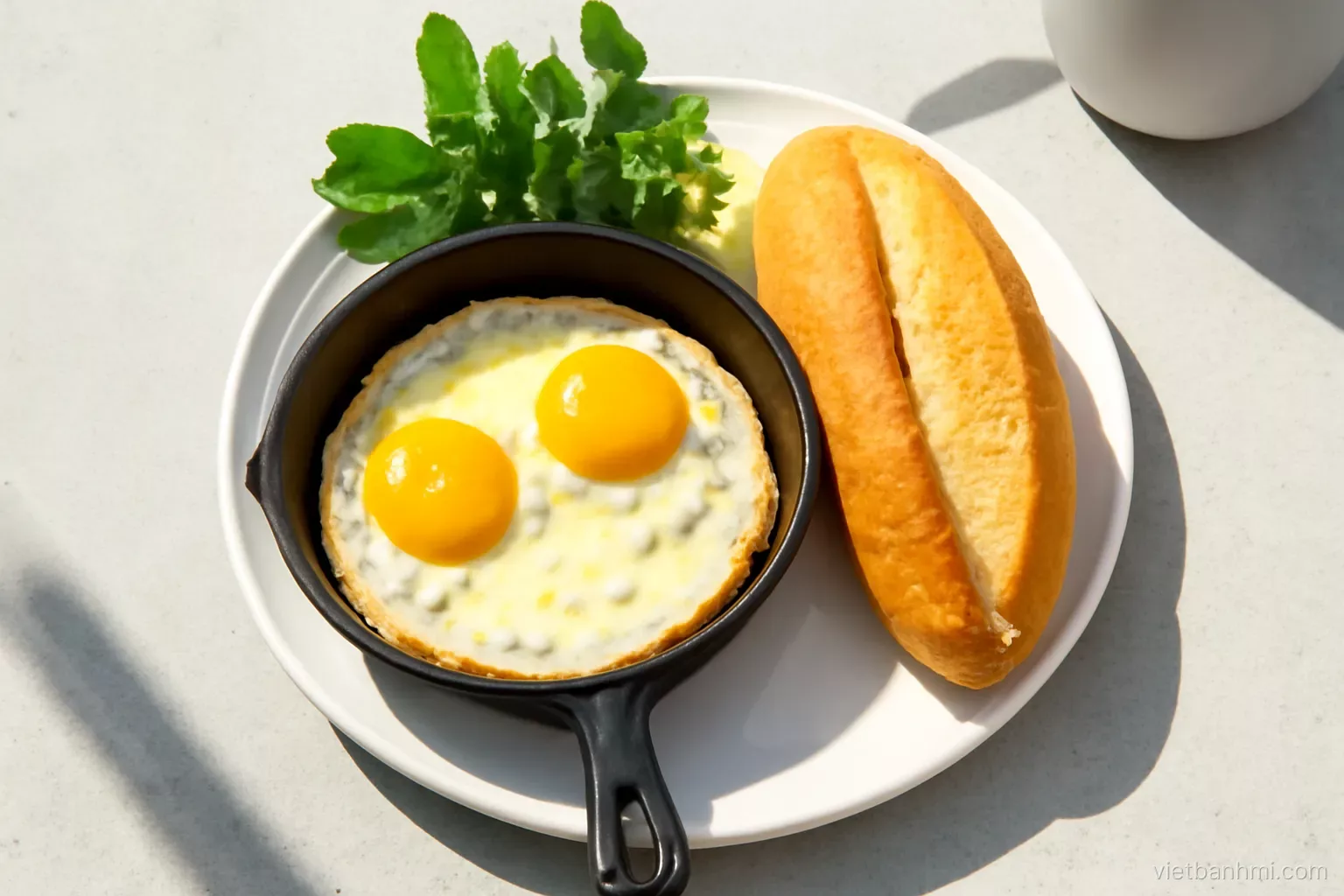
Short answer: Bánh mì chảo ("pan banh mi") is a sit-down Vietnamese breakfast: fried eggs, pâté, sausage, cold cuts and sometimes meatballs served sizzling in a small hot pan, with a crisp baguette on the side for tearing and dipping, plus a little salad of pickles, cucumber and herbs. It is eaten with a fork and the bread, not as a sandwich, and is especially popular in Saigon on weekend mornings.
What bánh mì chảo is
Chảo means pan, and that is the whole idea: instead of stuffing the fillings into the bread, the cook serves them hot in a small single-portion pan — cast iron or aluminium — that keeps sizzling as it reaches your table. You get the loaf separately, warm and crackly, and use it to scoop up runny egg yolk, pâté and sauce. It is closer in spirit to a Western cooked breakfast than to a street sandwich, and it takes longer to eat, which is why it is usually served at shops with tables and plastic stools rather than from carts.
Saigon's best-known name for this style is Bánh Mì Hòa Mã, which opened in 1958 and is widely credited with shaping the modern banh mi sandwich; today it is best known for its pan breakfast. Many other shops across the south and in Hanoi serve their own versions, and the dish has become a staple of weekend breakfasts with family or friends.
What comes in the pan
Every shop builds its own pan, but most draw from the same list. A standard pan usually has eggs and two or three meats; you can often add extras.
| Component | Vietnamese | Notes |
|---|---|---|
| Fried eggs | trứng ốp la | Usually two, sunny side up, yolks runny |
| Pâté | pa tê | Warmed in the pan so it softens into a spread |
| Sausage | xúc xích or lạp xưởng | Western-style hot dog sausage or sweet Chinese sausage |
| Cold cuts | chả lụa, ham | Pan-fried slices |
| Meatballs | xíu mại | In tomato sauce, at some shops |
| Beef | bò | Steak-style pans are a separate dish called bò né |
| Side salad | đồ chua, cucumber, tomato, herbs | Cuts the richness |
| Bread | bánh mì | Served on the side; extra loaves usually available |
Condiments sit on the table: chili sauce, soy or seasoning sauce, black pepper, sometimes fresh chili. Locals season the pan themselves, cracking pepper over the eggs and adding a few drops of soy before dipping.
How to eat it
There is no strict etiquette, but there is a sensible order that gets the most out of the pan:
- Season first. Add pepper, a little soy or seasoning sauce and chili sauce while the pan is still sizzling.
- Break the yolks. Let them run into the pâté and sauce to make a rich dip.
- Tear, don't cut. Break off pieces of bread and use them to scoop eggs and pâté.
- Alternate with salad. A bite of pickles and cucumber between bread-dips keeps the meal from feeling heavy.
- Finish with the bread. Wipe the pan clean with the last piece — it is the best bite.
Many shops will give you scissors or a knife, and some customers make a mini sandwich at the end by stuffing the remaining pan contents into the loaf. Eat at a steady pace; the pan cools within about ten minutes and the eggs keep cooking in the hot metal until then.
How the cook builds a pan
Watching a busy pan shop is part of the fun. The cook keeps a row of small pans heating over gas burners, adds a little oil or margarine, and cracks in the eggs first, because they take the longest. Slices of cold cut and sausage go in around the edges to sear, then a spoonful of pâté and, at some shops, a ladle of meatballs and sauce. The whole process takes three or four minutes, and the pan is carried to your table while the fat is still spitting — keep sleeves and phones back for the first moment. The bread is usually reheated separately so that it arrives crisp.
You will find pan shops mostly in residential neighbourhoods, near markets and on busy commuter streets rather than in tourist strips. They are often family businesses with a few tables on the pavement, busiest with locals on the way to work or school. If you are staying in a central hotel, ask staff for the nearest place their own families go; it will usually be within a short walk or ride.
Prices and when to go
Bánh mì chảo costs more than a street sandwich because it is a bigger, cooked-to-order meal. In Saigon, an ordinary neighbourhood shop commonly charges around 35,000–60,000đ (about US$1.35–2.30) for a standard pan, with extras raising the price; well-known older shops and those in tourist areas charge more. Hanoi prices are similar.
This is a breakfast dish. Many shops open around 6 a.m. and do most of their trade before 10 a.m., and some close by late morning. Weekend mornings are busiest, when families come out together. If you want a quiet table, go early on a weekday.
Bánh mì chảo versus other breakfasts with bread
Vietnam has several breakfasts that use the loaf as a side rather than a wrapper, and they are easy to confuse:
- Bánh mì ốp la — fried eggs on a plate or in a pan with bread, the simplest version, often without meats.
- Bò né — a sizzling plate of thin beef steak with egg, pâté and sometimes sausage, with bread; sometimes nicknamed "dancing beef" for how it sizzles.
- Bò kho — a southern beef stew with lemongrass and star anise, eaten with bread for dipping or with noodles.
- Bánh mì xíu mại — meatballs in tomato sauce or broth with bread, a Đà Lạt specialty in its bowl form.
All share the same logic: crisp bread and a rich, saucy main. Our regional styles section covers the meatball version, and our Saigon Food Guide has more breakfast ideas by area.
Vegetarian and vegan pans
A standard pan is firmly not vegetarian — pâté, sausage and cold cuts are all pork. Some Buddhist vegetarian restaurants serve a bánh mì chảo chay with tofu, mushrooms, plant-based sausage and vegetarian pâté, sometimes with egg (ask if you are vegan). Outside dedicated vegetarian places, asking a regular shop to "just leave out the meat" usually leaves you with eggs cooked in the same pan and fat, which may not suit you.
If you want to recreate the idea at home, it is easy: heat a small cast-iron pan until very hot, add a little oil, then sear slices of firm tofu and mushrooms for 3–4 minutes, add a spoonful of plant-based pâté to warm through, season with soy and pepper, and serve straight from the pan with a toasted baguette and quick pickles. Our sister site vegetarianbanhmi.com has full vegetarian recipes.
Common mistakes
First-timers often treat the pan like a plate and wait for it to cool before eating; by then the bread has gone soft and the eggs are overcooked. Others order a pan at 11 a.m. and find the shop sold out or closing. A third mistake is ignoring the salad — without the pickles and herbs, a pan of eggs, pâté and sausage can feel very heavy in Saigon's heat. Eat it hot, early, and with the greens.
Sources
- Saigoneer – saigoneer.com ("The Saga of the Bánh Mì"; "Three of Saigon's Oldest Banh Mi Shops")
- Plo – plo.vn (Pháp Luật TP.HCM, history of Bánh Mì Hòa Mã)
- Vietnam National Authority of Tourism – vietnamtourism.gov.vn
Frequently asked questions
What does bánh mì chảo mean?
It means "pan banh mi": fillings like eggs, pâté and sausage served hot in a small pan, with bread on the side for dipping, instead of inside a sandwich.
When do Vietnamese people eat bánh mì chảo?
Mainly at breakfast, from about 6 to 10 a.m. Weekend mornings are especially busy, and many shops close by late morning.
How much does bánh mì chảo cost?
In Saigon a standard pan at a neighbourhood shop is commonly around 35,000–60,000đ, with extras and famous shops costing more.
Is bánh mì chảo the same as bò né?
They are related but different. Bò né centres on sizzling beef steak, while bánh mì chảo centres on eggs, pâté, sausage and cold cuts. Both come with bread.
Is there a vegan bánh mì chảo?
Some Buddhist vegetarian restaurants serve a vegetarian pan with tofu, mushrooms and plant-based sausage; check about egg if you are vegan. At regular shops, simply removing the meat is not reliably vegetarian.
Early start or late finish? Vegan banh mi is always on
Pan breakfasts end by late morning, but hunger does not keep office hours. Bánh Mì XANH serves fully vegan banh mi around the clock at five central Saigon shops — good for an early start before a day trip or a meal at any hour. Try the Đậu Hũ Cay spicy tofu for something hearty.
Find the nearest Bánh Mì XANH · 24/7 hotline / Zalo +84 923 183 183