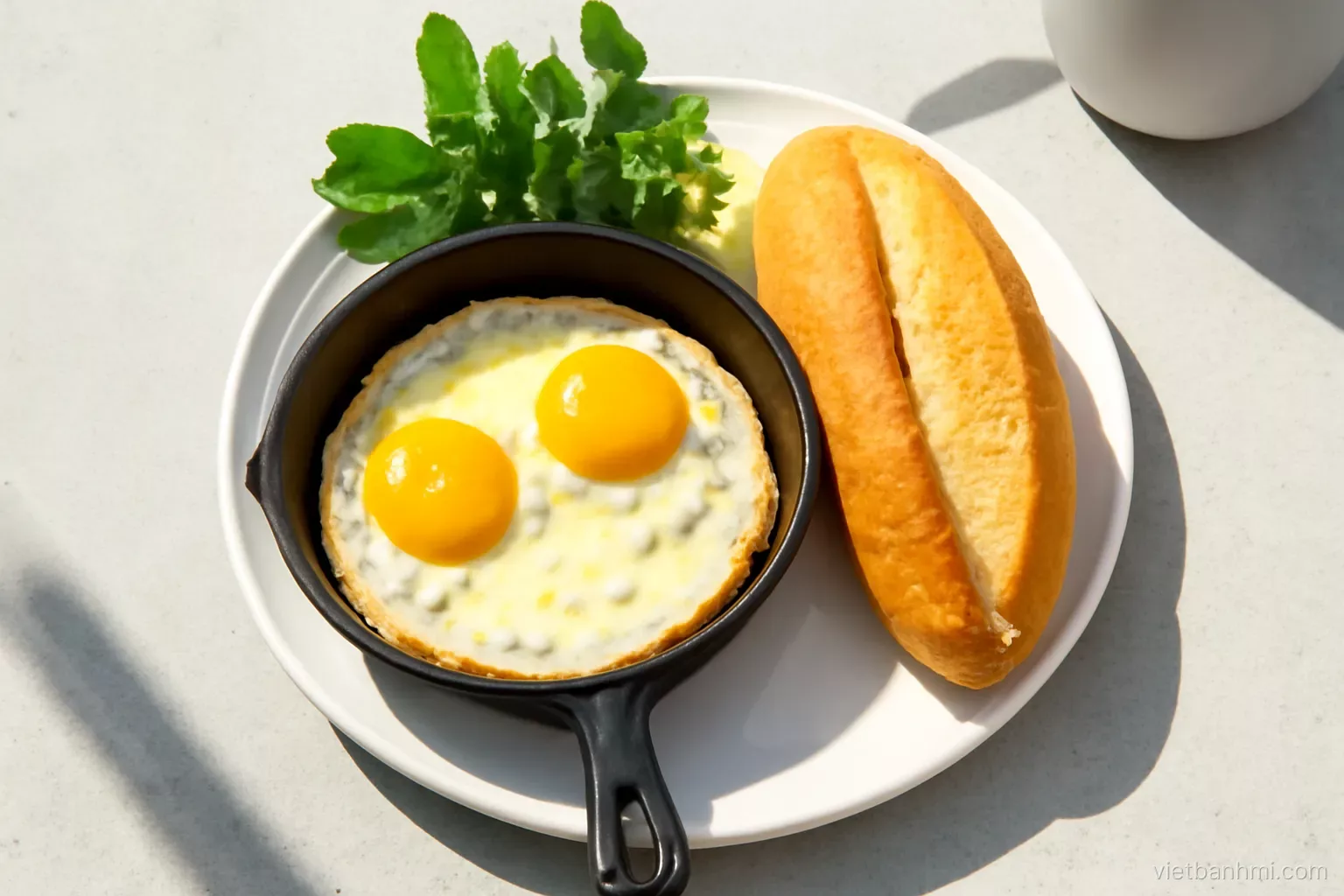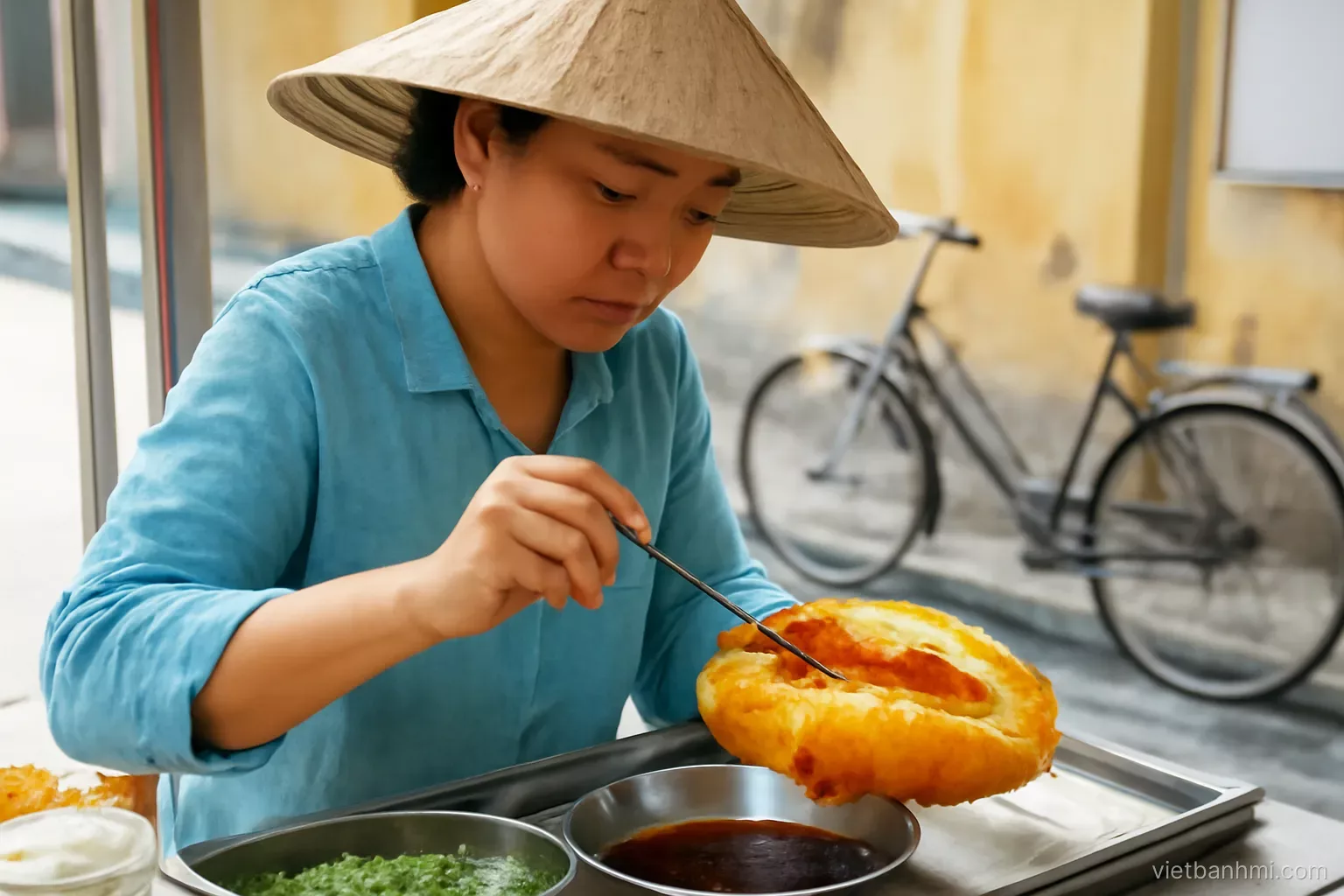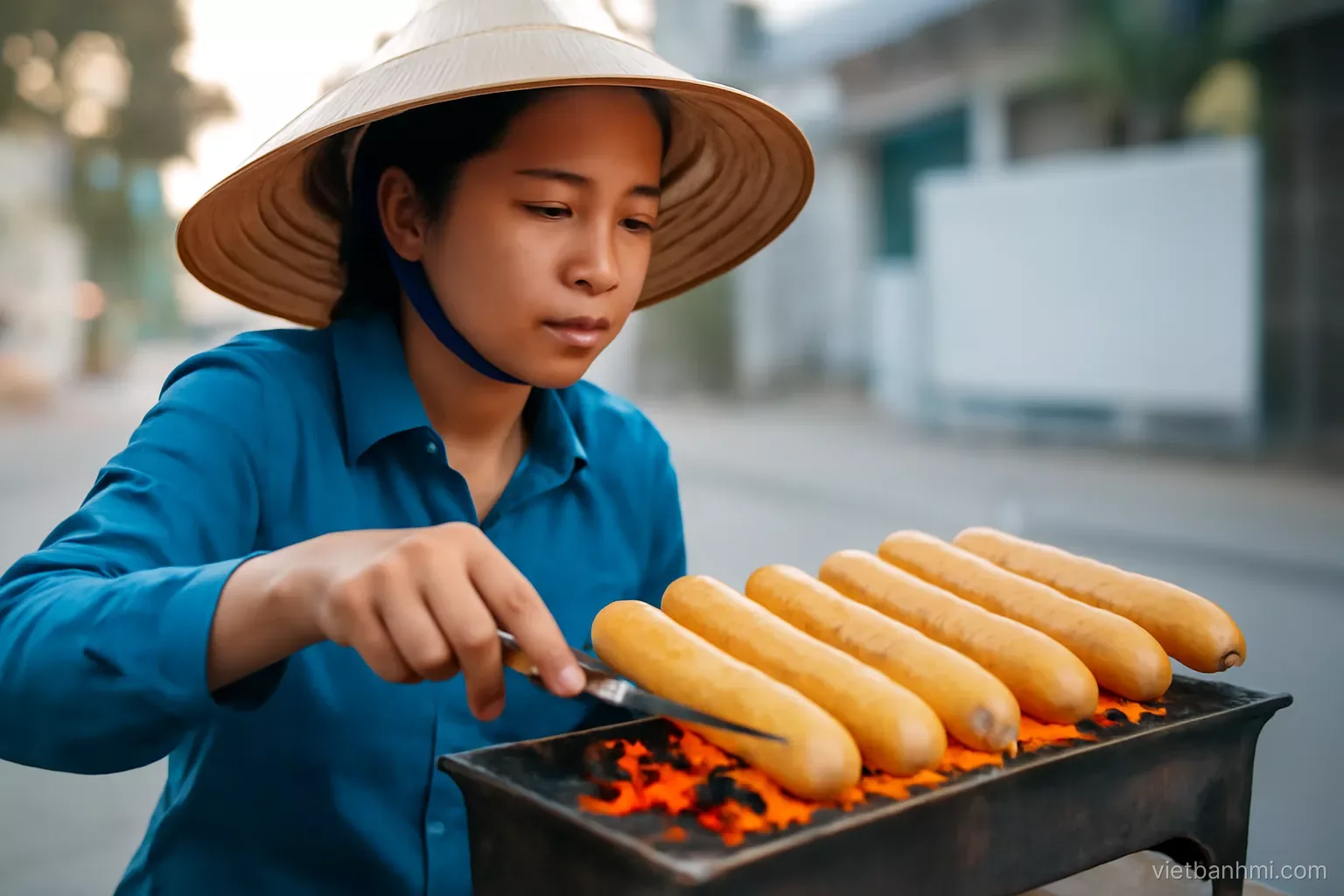
Short answer: Bánh mì que ("stick banh mi"), also called bánh mì cay ("spicy banh mi"), is Hải Phòng's signature bread snack: a crisp loaf about a finger wide and a hand long, filled with pork liver pâté and a fiery chili sauce, then toasted. It costs only a few thousand dong per stick, so people buy several at once, and it is now sold in Hanoi, Đà Nẵng and Saigon too.
What it is, exactly
Hải Phòng is a port city in northern Vietnam, about 120 km east of Hanoi, with a strong street food culture of its own — it is also famous for bánh đa cua (crab noodle soup). Its banh mi takes the opposite approach to Saigon's loaded sandwich. Instead of a big loaf with many fillings, it is a thin stick of bread with just two: pâté and chili sauce. That is all, and it is the point.
The name describes it. Que means stick, and the loaf is roughly the width of a finger and the length of a hand. The other name, bánh mì cay, refers to the chili. Vendors typically split the sticks, spread pâté inside, add chili sauce, and toast them over charcoal or in a small oven until the crust is very crisp. Some vendors add a little butter, and in other cities you may find versions with extra fillings, but the Hải Phòng original stays minimal.
The pâté and the chili
Because there is nothing else in the loaf, the two fillings carry everything. The pâté is usually made from pork, pork liver and some fat, seasoned with shallots, pepper and spices; Vietnamese sources describe local recipes that also use aromatic herbs and long pepper, with each family having its own formula. It is softer and more savoury than the pâté on a typical southern sandwich.
The chili sauce is the other half of the identity. Locals call it tương ớt or by the name chí chương, which Vietnamese writers connect to the city's historical Chinese-Vietnamese community. It is a thick, bright red, garlicky sauce that is hotter than most visitors expect. The balance between rich pâté and sharp chili, with a shattering crust, is what makes the snack addictive.
Where it came from
The origins are only partly documented. Vietnamese accounts generally say bánh mì que spread in Hải Phòng from around the 1980s, with roots in small family shops in the old town, and no single inventor is firmly established. The Vietnam National Authority of Tourism has written about a long-running shop on Lê Lợi street run by a woman known locally as "Bà Già" (the old lady), which is often cited as one of the most famous. Different families claim different starting dates, so treat any precise "invented in" year with caution.
What is clear is that the snack fits Hải Phòng's character: cheap, quick, spicy and sold everywhere from street corners to school gates. Its success later carried it to other cities, where it became a popular snack in its own right.
How locals eat it
Bánh mì que is a snack rather than a meal. Because each stick is small, people order by the handful — five or ten at a time — and share them, or eat a few with a drink in the afternoon or evening. Students and office workers buy them on the way home. A few things to know:
- Order in numbers. Say how many sticks you want, for example năm cái (five).
- Eat them hot. The crust is the best part and softens quickly.
- Control the chili. Ask for ít cay (a little spicy) — the default can be very hot.
- Expect no vegetables. No pickles, herbs or cucumber in the traditional version.
Prices and comparison with other styles
| Style | Size | Fillings | Typical price |
|---|---|---|---|
| Hải Phòng bánh mì que | Finger-thin, hand-length | Pâté, chili sauce | A few thousand dong per stick |
| Hanoi pâté banh mi | Standard loaf | Pâté, a little cold cut | Around 15,000–35,000đ |
| Saigon special | Standard loaf | Pâté, mayo, several meats, pickles, herbs | Around 20,000–40,000đ |
Prices change, and a stick in Hải Phòng is cheap enough that a generous snack for two costs less than one loaded sandwich in Saigon. In other cities bánh mì que is usually priced higher than in Hải Phòng, especially when sold by specialist brands. For more on regional styles, see our regional banh mi section.
Getting there and where else to find it
Hải Phòng is a straightforward day trip from Hanoi: around two hours by car or bus depending on traffic, and there is also a train service. The city is also a gateway to Cát Bà Island and Lan Hạ Bay, so many travellers pass through on the way. If you are staying in Hanoi, plan to eat bánh mì que in the late afternoon in Hải Phòng's old centre and combine it with a bowl of crab noodle soup earlier in the day.
You do not have to travel to Hải Phòng to try it, though. Shops selling Hải Phòng-style sticks are common in Hanoi, and Đà Nẵng has its own well-known stick banh mi scene. In Saigon you can find bánh mì que from specialist sellers and delivery apps. The versions outside Hải Phòng sometimes add extra fillings like pork floss or cheese, which locals tend to see as a different snack.
Vegetarian versions
The traditional stick is not vegetarian: the pâté is pork and liver. Some modern sellers offer vegetarian sticks with mushroom or soy-based pâté, but they are not the norm, especially in Hải Phòng itself. Vegans should also ask about the chili sauce, which is usually plant-based but may vary by recipe. If you want the idea — crisp bread, rich spread, sharp chili — without the meat, a vegan banh mi with spicy tofu is the closest everyday equivalent. Our Vegan Banh Mi section covers what to look for.
What a good stick tastes like
Because bánh mì que is so simple, it is easy to judge. A good stick is hot all the way through, with a crust that cracks loudly and breaks into thin shards rather than bending. The pâté should be warm and soft, spread thinly enough that it melts into the crumb but thickly enough that every bite tastes of it — rich, peppery and savoury rather than metallic. The chili sauce should taste of garlic and fruit as well as heat. A weak stick is the reverse: lukewarm, chewy, with a cold smear of pâté and a sauce that is only hot. Vendors with charcoal grills and a constant queue tend to get it right because their sticks never sit around.
Locals also judge by smell. The scent of toasting bread and warm pâté drifting from a small shopfront in the late afternoon is the best advertisement a stall can have.
Common mistakes
Visitors most often go wrong in three ways. They order one stick and judge it as a meal, when it is meant to be eaten by the handful as a snack. They accept the default chili and spend the next ten minutes recovering. And they buy sticks to take back to the hotel, by which time the crust has gone soft. Order several, specify the heat, and eat them standing at the stall while they are still crackling.
Sources
- Vietnam National Authority of Tourism – vietnamtourism.vn ("Taking a salty, spicy bite of Hai Phong cuisine")
- Hai Phong City Portal – haiphong.gov.vn
- Vietnam Railways – dsvn.vn (Hanoi–Hai Phong train service)
Frequently asked questions
What is the difference between bánh mì que and regular banh mi?
Bánh mì que is a thin, finger-width stick filled only with pâté and chili sauce and toasted very crisp. Regular banh mi is a larger loaf with several fillings, pickles and herbs.
How spicy is Hải Phòng banh mi?
It can be very spicy, since the chili sauce is a main ingredient. Ask for ít cay for a milder version or không cay for none.
How many sticks should I order?
Locals often order five to ten to share as a snack. Two or three per person is a sensible start if you are eating other things the same day.
Can I find bánh mì que in Hanoi or Saigon?
Yes. Hải Phòng-style sticks are sold in Hanoi, Đà Nẵng has its own popular version, and you can find them in Saigon from specialist sellers and delivery apps.
Is bánh mì que vegetarian?
Traditionally no, because the pâté is made from pork and liver. Some modern sellers make vegetarian versions, but they are uncommon in Hải Phòng.
Crave heat and crunch without the pâté?
The appeal of Hải Phòng sticks is crisp bread with a rich spread and serious chili. In Saigon, Bánh Mì XANH delivers a similar kick in fully vegan form — try the Đậu Hũ Cay spicy tofu banh mi at any of its five central shops, open 24/7, or have it delivered.
Order a spicy tofu banh mi · 24/7 hotline / Zalo +84 923 183 183