Short answer: Southern Vietnam beyond central Saigon has its own banh mi favourites: bánh mì nướng muối ớt (flattened bread grilled with chili-salt and spring onion oil, linked to An Giang and Khmer cooking), bánh mì bì (shredded pork and pork skin), roast pork with crackling, and bread eaten with stews like bò kho and curry. Most cost around 15,000–35,000đ, and the region's Buddhist traditions make vegetarian versions relatively easy to find.
Why the south is a banh mi heartland
The south is where banh mi as a loaded sandwich took shape, and the Mekong Delta — with its rice fields, orchards, vegetable gardens and river markets — supplies Saigon with much of its produce. Southern cooking is known for generous herbs, pickles and a sweeter balance than the north, and the region is home to Khmer, Chinese-Vietnamese and Cham communities whose food has blended into everyday street eating. All of that shows up in bread: more fillings, more vegetables, and some styles found mainly in the south.
Many travellers only meet these styles in Saigon, where people from the delta have brought them. That works fine — several are now as common in the city as in the provinces — but if you take a trip into the delta, you will see them in their home context at morning markets and roadside stalls.
Bánh mì nướng muối ớt: chili-salt grilled bread
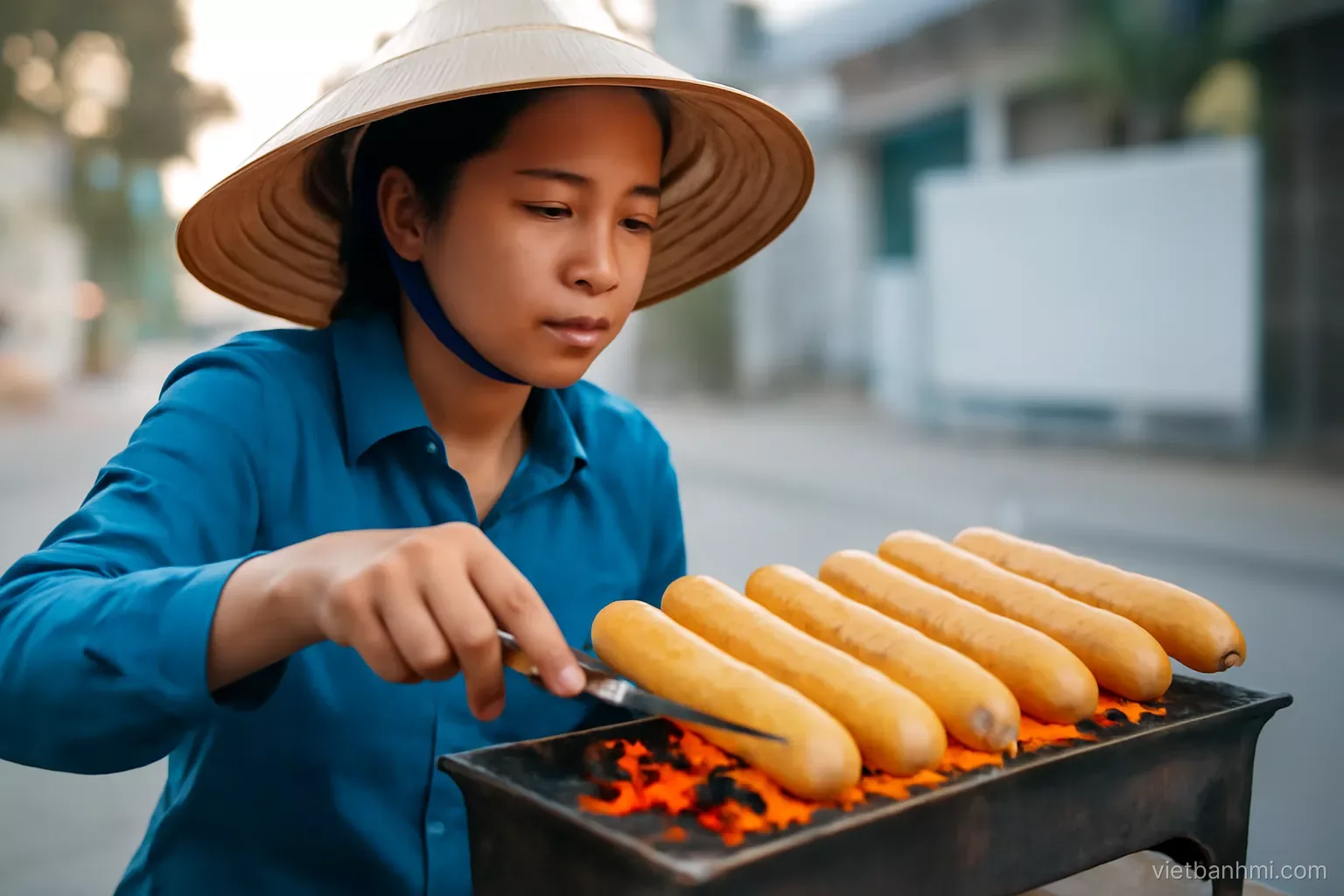
This is the most distinctive southern bread snack and one of the most fun to watch being made. A loaf is split, flattened, brushed with butter or margarine, spread with toppings such as pâté, spring onion oil, chili-salt and often a sweet-savoury sauce, sometimes with pork floss, quail eggs or sausage, then grilled flat over charcoal until crisp and smoky. It is cut into pieces and eaten hot.
Vietnamese sources link the dish to An Giang province in the Mekong Delta, and Tuoi Tre News has described it as a Khmer-style bread. In Saigon it became a street craze in the 2010s, with stalls clustering in the area of former District 6 around Lê Quang Sung street, among other places. Prices are low — commonly around 15,000–30,000đ — and it is an afternoon and evening snack rather than breakfast.
Bánh mì bì: shredded pork and skin
Bì is a southern ingredient of thinly shredded pork skin and lean pork mixed with thính (toasted rice powder), which gives a nutty aroma and a slightly chewy texture. In a banh mi, bì is usually combined with spring onion oil, pickles, herbs and a drizzle of sweet-salty sauce. It is also eaten with broken rice and noodles, so you will see it on rice stalls too. A bì banh mi from a cart commonly costs around 15,000–25,000đ.
Roast pork, stews and other southern classics
Several other styles are especially common in the south:
- Bánh mì heo quay — roast pork belly with crackling, chopped to order, often with a sweet-salty sauce and pickles. Carts selling only roast pork have devoted followings.
- Bánh mì xíu mại — pork meatballs in tomato sauce inside the loaf, a breakfast favourite.
- Bò kho with bread — beef stew with lemongrass, star anise and carrot, eaten with bread for dipping at breakfast.
- Cà ri with bread — a mild, coconut-rich Vietnamese curry, often chicken, served with a baguette.
- Phá lấu with bread — a Chinese-Vietnamese stew of offal in five-spice and coconut broth, popular as an afternoon snack in Saigon.
| Style | Main components | When to eat | Typical price |
|---|---|---|---|
| Bánh mì nướng muối ớt | Flattened grilled bread, chili-salt, scallion oil, pâté | Afternoon, evening | Around 15,000–30,000đ |
| Bánh mì bì | Shredded pork and skin, toasted rice powder | Morning, lunch | Around 15,000–25,000đ |
| Bánh mì heo quay | Roast pork with crackling | All day | Around 25,000–40,000đ |
| Bò kho with bread | Beef stew, bread for dipping | Breakfast | Around 35,000–60,000đ |
| Cà ri with bread | Coconut curry, bread | Breakfast, lunch | Around 35,000–55,000đ |
Prices are orientation ranges for late 2026 and vary between Saigon and provincial towns, which are usually a little cheaper.
How chili-salt bread is made
Stalls vary, but the sequence at a typical bánh mì nướng muối ớt stall looks like this:
- The vendor splits a loaf and presses it flat with a hand or a small board, so it grills evenly.
- Butter or margarine is brushed over the cut side, followed by a layer of pâté.
- Spring onion oil, chili-salt and a sweet-savoury sauce go on top; some stalls add pork floss, sausage or a cracked quail egg.
- The bread goes onto a wire rack over charcoal and is turned several times until both sides are crisp and lightly charred.
- It is cut into strips with scissors and served in a paper bag or on a plate, often with extra chili-salt on the side.
The whole process takes a few minutes per loaf, and stalls often have a small queue in the late afternoon. Ask for ít cay if you want the chili-salt dialled down.
Eating banh mi on a Mekong Delta trip
Most visitors reach the delta on a day trip or overnight tour from Saigon. Cần Thơ, the largest city in the delta, is roughly three to four hours from Saigon by road depending on traffic. Floating markets start very early, so breakfast is often a banh mi or a bowl of noodles bought at dawn near the river. A few practical tips:
- Eat at morning markets. Stalls near markets have the freshest bread and fastest turnover between about 6 and 9 a.m.
- Carry small notes. Provincial stalls are less likely to accept QR payments from foreign apps, and change for large notes can be scarce.
- Watch the heat. Midday in the delta is hot and humid; eat sandwiches promptly and stay hydrated.
- Ask about chili. Chili-salt bread in particular can be very spicy.
For full itineraries combining Saigon and the delta, see our Food Trip Planning section.
Vegetarian banh mi in the south
Southern Vietnam has a strong Buddhist vegetarian culture, and on the 1st and 15th days of the lunar month many people eat chay. That makes vegetarian banh mi easier to find than in the north: stalls near pagodas and markets often sell bánh mì chay with tofu, mushrooms, vegetarian pork roll and soy-based floss. There are vegetarian versions of chili-salt grilled bread too, with plant-based pâté and floss.
The caveats are familiar: egg mayonnaise and margarine may not suit vegans, and sauces at ordinary stalls may contain fish sauce. For strict diets, look for a dedicated vegetarian or vegan shop. In Saigon, the city centre now has fully vegan banh mi shops that remove the guesswork entirely. Phrases and tips are in our Eating Vegan in Vietnam section.
Common mistakes
Visitors sometimes assume every southern banh mi is the same loaded Saigon sandwich and miss the regional snacks entirely. Another common mistake is looking for chili-salt grilled bread at breakfast, when most stalls open in the afternoon. And travellers on delta tours often skip market food for tour lunches; a 20,000đ banh mi at a dawn market is usually the more memorable meal.
Sources
- Tuoi Tre News – tuoitrenews.vn ("Saigonese embrace Khmer-style bread grilled with chili salt", 2016)
- Vietnam National Authority of Tourism – vietnamtourism.gov.vn
- Can Tho City Portal – cantho.gov.vn
Frequently asked questions
What is bánh mì nướng muối ớt?
It is flattened bread brushed with butter or margarine, topped with chili-salt, spring onion oil, pâté and other toppings, then grilled over charcoal until crisp. It is linked to An Giang province and Khmer cooking and is popular in Saigon as an afternoon snack.
What is bì in bánh mì bì?
Bì is thinly shredded pork skin and lean pork mixed with toasted rice powder. It has a nutty, slightly chewy texture and is common in southern banh mi and broken rice dishes.
Do people eat bread with stew in Vietnam?
Yes, especially in the south. Bò kho (beef stew), curry and phá lấu are often eaten with a baguette for dipping, usually at breakfast or as an afternoon snack.
Is vegetarian banh mi easy to find in the Mekong Delta?
Easier than in many places, thanks to the region's Buddhist traditions, especially near pagodas and on lunar fasting days. For strict vegan food, dedicated vegetarian shops are safest.
How far is the Mekong Delta from Saigon?
The nearest delta towns are one to two hours from Saigon, and Cần Thơ is roughly three to four hours by road. Many visitors go on day trips or overnight tours.
Southern flavours, fully vegan, in central Saigon
Before or after your delta trip, Bánh Mì XANH offers fully vegan banh mi, from spicy tofu to the mixed Thập Cẩm, at five central Saigon shops, open 24/7. The Chả Lát Chay, a grain-based vegan cold cut, is a good way to taste the classic southern sandwich without pork, and delivery can be ordered online.
Order Bánh Mì XANH delivery · 24/7 hotline / Zalo +84 923 183 183