Short answer: You can order almost any banh mi with about fifteen words: the filling name after bánh mì (for example thịt, meat; trứng, egg; chay, vegetarian), a number plus ổ (loaf), and a few modifiers such as không cay (no chili), không ngò (no cilantro) and mang về (take away). Pointing works too, but knowing these words lets you customise and avoid surprises.
How banh mi names work
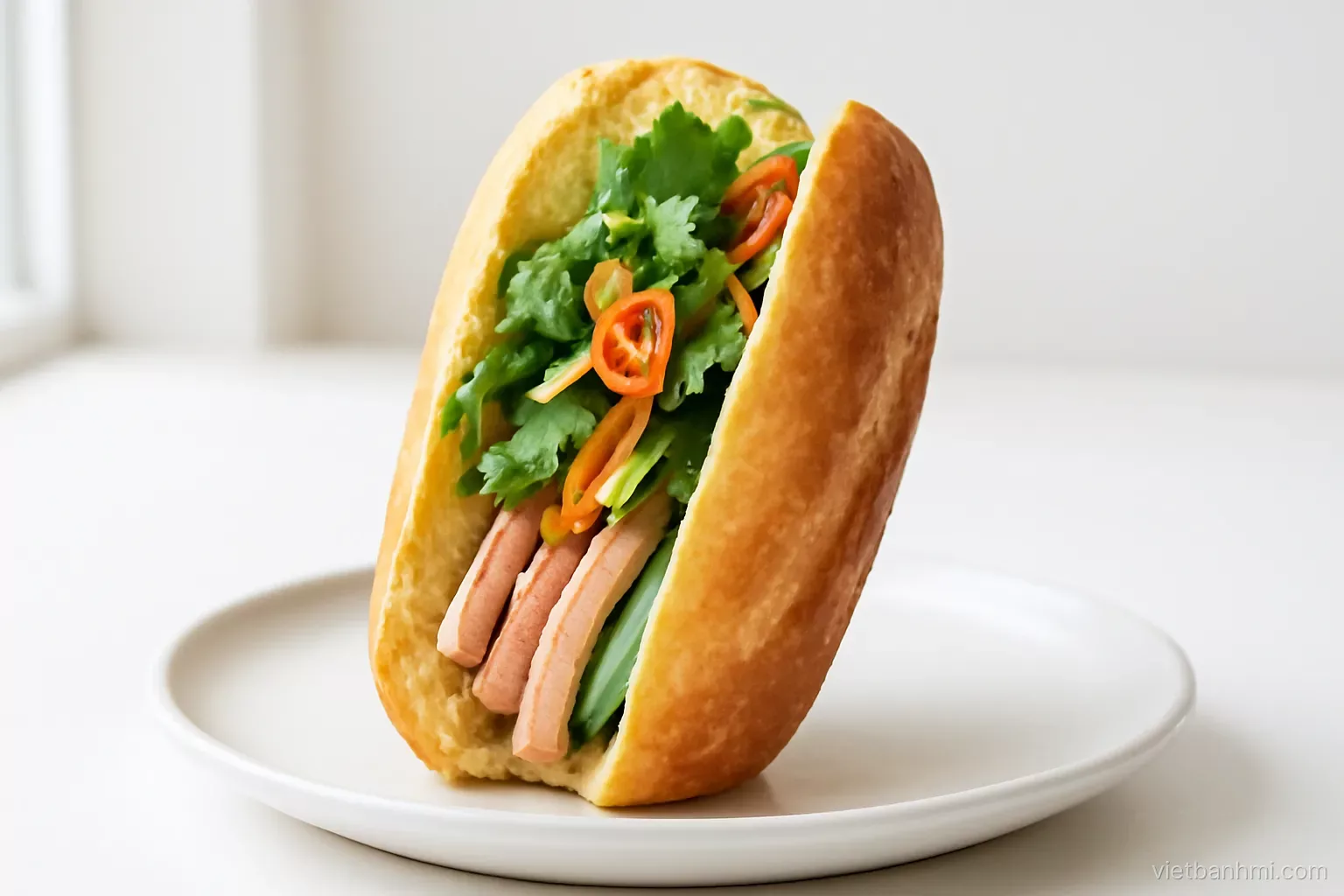
Vietnamese food names are built like labels: the dish first, then what makes it different. So bánh mì plus thịt nướng (grilled pork) gives bánh mì thịt nướng, grilled pork banh mi. Once you know this pattern you can decode almost any cart, because the filling word is usually painted or printed right after "bánh mì". Many carts specialise in one or two fillings, so the name on the cart is effectively the whole menu.
Vietnamese is tonal, and the marks above and below letters change the meaning. You do not need perfect tones to order food — vendors hear tourists all day and context does the rest — but saying the words slowly and pointing at the same time removes any doubt.
Fillings you will see on carts
| Vietnamese | Rough pronunciation | Meaning |
|---|---|---|
| bánh mì thịt | bun mee tit | with meat (usually mixed cold cuts and pâté) |
| bánh mì đặc biệt | bun mee dak byet | "special" — the loaded house version |
| bánh mì thịt nướng | bun mee tit nuhng | grilled pork |
| bánh mì heo quay | bun mee heh-oh kway | roast pork with crackling |
| bánh mì gà | bun mee gah | chicken |
| bánh mì trứng / ốp la | bun mee chung / op lah | egg / fried egg |
| bánh mì xíu mại | bun mee syoo my | meatballs in tomato sauce |
| bánh mì chả cá | bun mee chah kah | fish cake |
| bánh mì bì | bun mee bee | shredded pork skin |
| bánh mì chay | bun mee chai | vegetarian (Buddhist style) |
| bánh mì đậu hũ | bun mee dow hoo | tofu |
| bánh mì bơ đường | bun mee buh duhng | butter and sugar (sweet snack) |
The pronunciations are rough English approximations of the southern accent, which is what you will hear most in Saigon. For what each filling actually contains, see our anatomy guide in Banh Mi 101.
Ingredient words for customising
These are the words you will use to add or remove things. Put không ("no", sounds like "khom") in front to remove, thêm ("tem", add more) to add, and ít ("it", a little) to reduce.
- ngò (ngaw) — cilantro. Không ngò = no cilantro.
- hành (hahn) — spring onion.
- ớt (uht) — chili. Cay (kai) — spicy.
- pa tê (pah teh) — pâté.
- bơ (buh) — the "butter" spread, usually homemade mayonnaise.
- đồ chua (doh choo-ah) — pickled carrot and daikon.
- dưa leo (zuh-ah leh-oh) — cucumber.
- nước tương (nuhk tuhng) — soy sauce.
- nước mắm (nuhk mum) — fish sauce.
- trứng (chung) — egg.
Numbers, quantities and paying
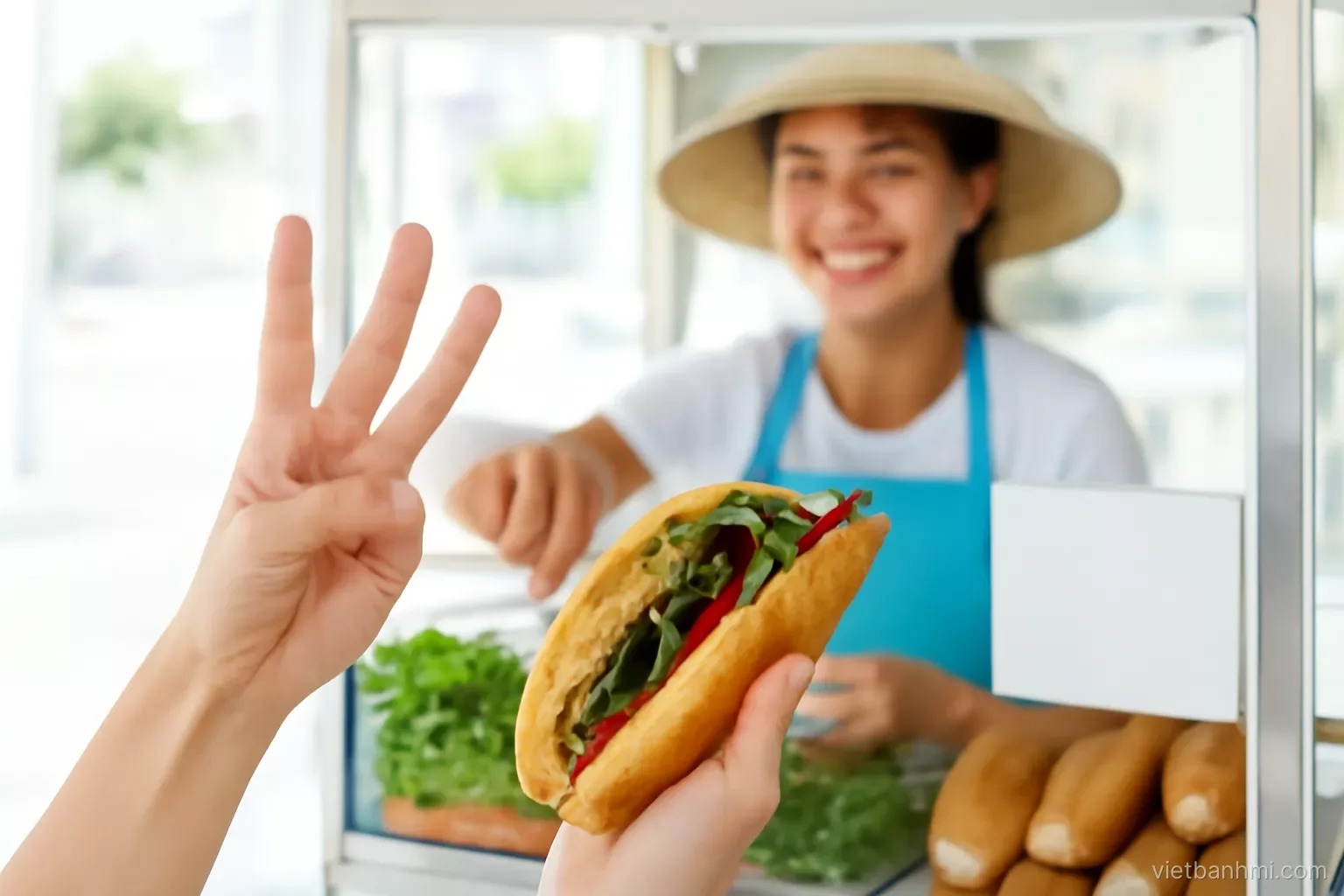
Loaves are counted with the word ổ: một ổ (one loaf), hai ổ (two), ba ổ (three), bốn ổ (four), năm ổ (five). In practice holding up fingers is fine. To ask the price, say bao nhiêu tiền? ("bow nyew tee-en", how much?). Vendors often answer with a shortened number: "hai lăm" means 25,000đ and "ba mươi" means 30,000đ — the thousands are understood.
Cash in small notes (10,000đ, 20,000đ, 50,000đ) is always welcome; arriving with a 500,000đ note at 6 a.m. can leave a cart without change. Many vendors now display a bank QR code for transfers — ask chuyển khoản được không? (can I transfer?) if you have a Vietnamese banking app or a QR-capable payment app. Tipping is not expected at street stalls.
Useful phrases from start to finish
- Cho tôi một ổ bánh mì thịt — "Give me one meat banh mi." (The polite, standard way to order.)
- Không cay / ít cay / cay nhiều — no chili / a little / lots.
- Nướng giòn giùm — please toast it crispy.
- Cắt đôi — cut it in half.
- Mang về — take away; ăn ở đây — eat here.
- Bao nhiêu tiền? — how much?
- Cảm ơn (gahm uhn) — thank you.
A complete order might sound like this example: "Cho tôi hai ổ bánh mì đặc biệt, một ổ không cay, mang về." — "Two special banh mi, one without chili, to take away." That is everything a vendor needs.
Vegetarian and allergy phrases
If you do not eat meat, tôi ăn chay (toy an chai) means "I eat vegetarian". In Vietnam chay refers to Buddhist vegetarian food, which traditionally excludes meat, fish and often pungent vegetables, but not always eggs or dairy. For a strictly plant-based meal add không trứng, không sữa (no egg, no milk) and không nước mắm (no fish sauce).
The weak point at an ordinary cart is not the words but the workflow: shared knives, shared spreads and sauces of unknown origin. If you have a serious allergy, carry a written card in Vietnamese and, when it matters, choose a dedicated vegetarian or vegan shop. Our Eating Vegan in Vietnam section has longer phrase lists and tips for fasting days.
North versus south: the same sandwich, different words
Most phrase guides teach southern Vietnamese, but if you travel the length of the country you will hear differences. Cilantro is ngò in the south and usually rau mùi in the north. Pork is heo in the south and lợn in the north, so roast pork may appear as heo quay in Saigon and lợn quay in Hanoi. Northerners often count loaves with cái or chiếc rather than ổ, and the polite "please" particle sounds different too. Older Hanoians sometimes still call bread bánh tây, the colonial-era name. None of this will stop you being understood — vendors everywhere know both sets of words — but recognising them makes signs and menus easier to read as you move north.
Reading a cart in thirty seconds
A typical banh mi cart is a glass cabinet with the loaves stacked on top and the fillings arranged in trays inside. Read it from left to right like a menu. Sliced pink and white rolls are cold cuts; a lacquered red meat is xá xíu; glistening golden pieces with crackling are roast pork; a pot of red sauce with round balls is xíu mại; a tray of eggs and a pan means fried-egg sandwiches are made to order. If you see trays of fried tofu, mushrooms and a separate cutting board, the vendor may make vegetarian loaves. Prices are often written on the glass. Even without reading a word, this visual scan tells you what is possible before you reach the front of the queue.
Mistakes that trip up visitors
A few things cause most misunderstandings. "Bơ" sounds like butter and is translated as butter, but on a sandwich cart it usually means egg mayonnaise — relevant if you avoid eggs. "Chay" on a cart sign means the vendor sells vegetarian loaves, not that the whole cart is meat-free. And "đặc biệt" means the vendor's fullest version, which almost always includes pâté and several pork products. When unsure, point at each tray and say có (yes) or không (no) — vendors are used to it.
Sources
- Vietnam National Authority of Tourism – vietnamtourism.gov.vn
- Oxford English Dictionary – oed.com (entry "banh mi")
- State Bank of Vietnam – sbv.gov.vn (Vietnamese dong banknote denominations)
Frequently asked questions
What does bánh mì đặc biệt mean?
It means "special banh mi", the vendor's fully loaded version. It usually includes pâté, mayonnaise and several kinds of pork such as pork roll, ham and barbecued pork, plus pickles and herbs.
How do I say no cilantro in Vietnamese?
Say không ngò, roughly "khom ngaw". In the north cilantro is often called rau mùi, so không rau mùi works there too.
Do I need to speak Vietnamese to buy banh mi?
No. Pointing and holding up fingers works everywhere, and vendors in tourist areas often know a few English words. A handful of Vietnamese words simply makes it easier to customise and avoid ingredients you do not want.
Is bánh mì chay always vegan?
Not necessarily. It is meat-free in the Buddhist sense but may include egg mayonnaise or butter, and at a meat cart it may share utensils. Ask about egg and dairy, or choose a dedicated vegan shop.
Can I pay for banh mi by card?
Street carts rarely take cards, but many accept bank QR transfers, and cash always works. Modern chains and cafés more often accept cards and e-wallets.
Skip the vegan phrasebook in Saigon
All the "không trứng, không nước mắm" phrases are unnecessary at Bánh Mì XANH, where every banh mi is fully vegan. Its five central Saigon shops are open 24/7, and the hotline and Zalo answer around the clock if you want to ask a question before ordering.
See the Bánh Mì XANH menu in English · 24/7 hotline / Zalo +84 923 183 183