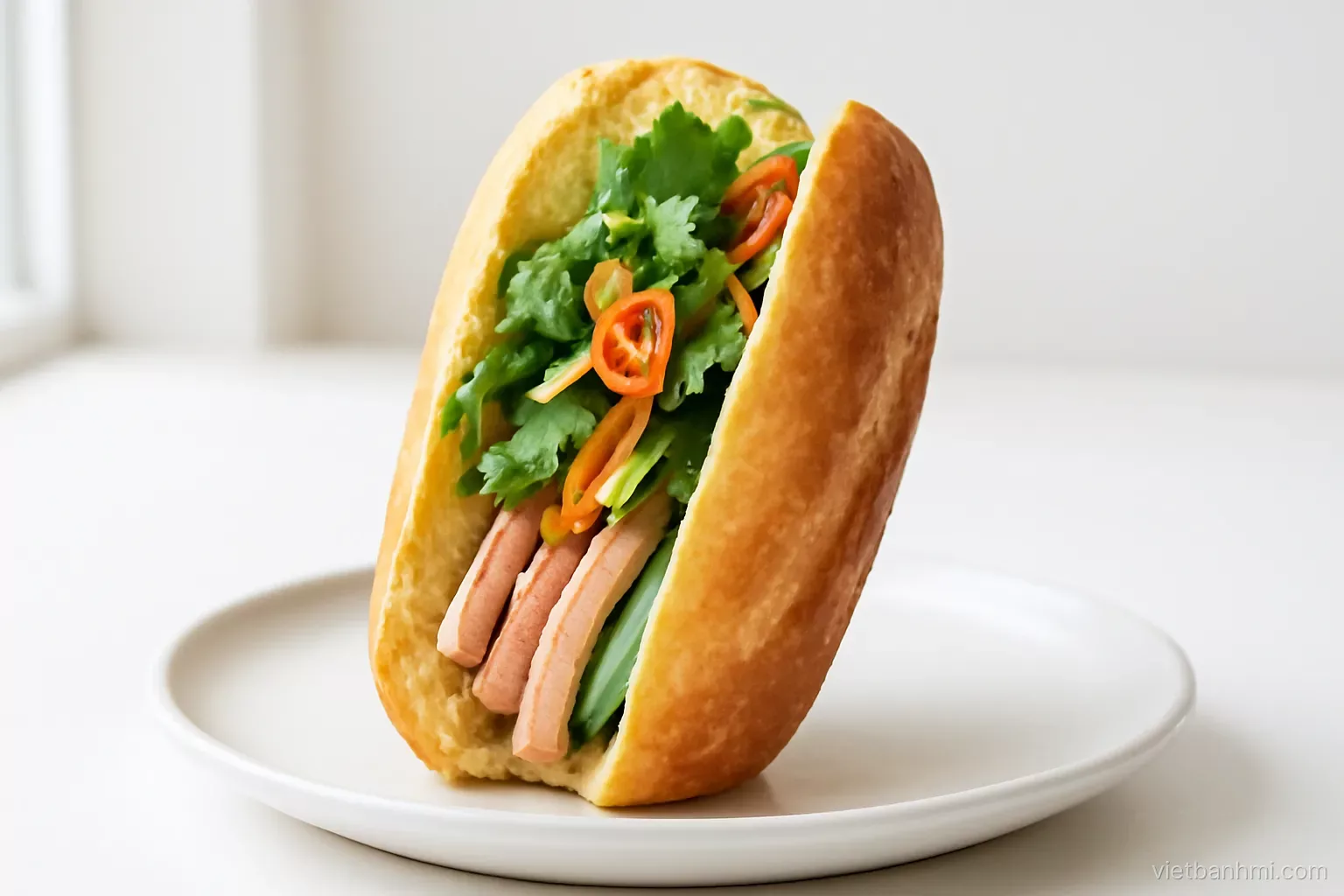
Short answer: Banh mi belongs to the same family as the po boy, the Cuban sandwich, the Mexican torta, the Italian-American sub and the French jambon-beurre: all are meals built on a white wheat loaf. What sets banh mi apart is the combination of a very light, crackly roll with bright, cold, acidic toppings (pickled carrot and daikon, cucumber, cilantro, fresh chili) layered over rich spreads and savory fillings. The result balances sweet, sour, salty and spicy in one bite, and in Vietnam it usually costs a fraction of what its cousins cost abroad.
Why compare banh mi with other sandwiches at all?
Most travelers arrive in Vietnam with a sandwich already in their head. Americans think of a sub from the corner deli or a po boy from New Orleans, Europeans picture a ham-and-butter baguette, and Latin American visitors know the torta. That mental template shapes the first bite, and it explains the two most common reactions to bánh mì (Vietnamese baguette sandwich): surprise at how light the bread is, and surprise at how much fresh, sour crunch is packed inside. Comparing the sandwiches side by side is a quick way to understand what banh mi is trying to do, and why it does not taste like any of them even when the ingredients look familiar.
It also helps with ordering. If you know that a banh mi is built around contrast rather than bulk, you stop expecting a pile of meat and cheese and start judging it the way locals do: is the crust shattering, are the pickles crisp, is there enough herb and chili to wake the whole thing up? If you are brand new to the sandwich, our Banh Mi 101 section covers the basics first.
The family tree: bread-based meals from colonial and immigrant kitchens
Every sandwich in this comparison grew out of a bakery tradition meeting a local kitchen. French bakers brought the baguette to Vietnam in the colonial period, and over the twentieth century Vietnamese cooks turned it into something of their own, with a shorter, lighter loaf and fillings drawn from Vietnamese charcuterie, pickles and herbs. The po boy came out of New Orleans, a city with its own deep French heritage, where long loaves of light French bread are stuffed with fried seafood or roast beef and gravy. The Cuban sandwich took shape among Cuban communities in Florida, with Tampa and Miami both claiming it, and is pressed flat on a griddle. The Mexican torta is built on soft rolls such as bolillo or telera, another descendant of European-style bread. The Italian-American sub, also called a hoagie, hero or grinder depending on the region, is a long roll packed with cured meats, cheese and dressed vegetables.
Seen this way, banh mi is less an exotic outlier than a sibling. What makes it distinctive is what Vietnamese cooks chose to add and, just as importantly, what they left out. Cheese is rare, lettuce is not the point, and there is almost never a thick layer of anything. The English-speaking world has noticed: the word "banh mi" was added to the Oxford English Dictionary in 2011, and Google celebrated the sandwich with a Doodle on 24 March 2020.
Side by side: six sandwiches compared
The table below compares typical versions, not every variation. Each of these sandwiches has dozens of local styles, so treat it as a map of tendencies rather than a rulebook.
| Sandwich | Home | Bread | Typical filling | Signature flavor | Served |
|---|---|---|---|---|---|
| Banh mi | Vietnam | Short, very light roll with a thin, crackly crust | Pork cold cuts, pâté, grilled meat, egg or tofu, plus pickles, cucumber, cilantro, chili | Sweet, sour, salty and spicy in balance | Warm bread, cool toppings, eaten in hand |
| Po boy | New Orleans, USA | Light French-style loaf, crisp outside | Fried shrimp or oyster, roast beef with gravy | Rich, savory, often messy | "Dressed" with lettuce, tomato, pickles, mayo |
| Cuban sandwich | Tampa and Miami, USA | Cuban bread, pressed flat | Roast pork, ham, Swiss cheese, pickles, mustard | Salty, tangy, melted | Hot, griddle-pressed |
| Torta | Mexico | Soft bolillo or telera roll | Meats, beans, avocado, cheese, jalapeños | Hearty, creamy, spicy | Often toasted or griddled |
| Sub / hoagie | USA (Italian-American) | Long, soft-to-chewy roll | Cured meats, provolone, lettuce, onion, oil and vinegar | Salty, meaty, vinegary | Cold or hot, often large |
| Jambon-beurre | France | Classic baguette, chewier crumb | Ham and butter | Simple, buttery, salty | Cold, minimalist |
Two patterns jump out. First, banh mi is the only sandwich here where fresh herbs and a quick pickle are not optional garnish but structural parts of the design. Second, it sits at the light end of the bread scale: closer to a po boy loaf than to a dense baguette or a soft torta roll.
What makes banh mi different, layer by layer
The difference is easiest to understand as a set of design choices. A typical street banh mi is built in this order, and each step pushes it away from its cousins:
- The bread. The Vietnamese loaf is shorter than a French baguette and much airier, with a crust so thin it crackles and sheds flakes. It feels almost hollow compared with a sub roll. If you want the baking science behind that texture, vegetarianbanhmi.com explains why banh mi bread is so light and crispy.
- The spreads. Instead of butter (jambon-beurre) or mustard (Cuban), the classic banh mi gets a swipe of liver pâté and a rich mayonnaise-style spread. They add fat and depth without bulk.
- The filling. Sliced Vietnamese pork roll (chả lụa), grilled pork, fried egg, meatballs or, in the vegetarian version, tofu and mushrooms. Portions are moderate; the filling is one voice among several, not the whole song.
- The pickles. Đồ chua (pickled carrot and daikon) brings sweet-sour crunch that cuts the richness. A po boy or a sub may have dill pickles or vinegar, but rarely in this quantity or with this sweetness.
- The fresh layer. Cucumber spears and sprigs of ngò (cilantro), sometimes scallion. This cold, green layer is the clearest dividing line between banh mi and every other sandwich on the list.
- Heat and seasoning. Sliced fresh chili or chili sauce, and a few drops of soy-based seasoning sauce. Heat is expected, not an extra.
Put together, you get a sandwich that is warm and cool, crisp and soft, rich and sharp at the same time. That contrast is the whole point. A sub or a torta wins on heft; a banh mi wins on balance.
What travelers notice first in Vietnam
When visitors eat their first banh mi on the street, the same observations come up again and again. The first is noise: the crust crackles loudly and scatters crumbs, and many people are surprised that the bread does not feel filling on its own. The second is the price. In Vietnam a basic street banh mi typically costs somewhere around 15,000 to 35,000 VND, roughly US$0.60 to US$1.35 at around 26,000 VND per USD (check current rate), while modern shops with premium fillings charge more, often 40,000 to 75,000 VND. Compared with a deli sub or a po boy in the United States, the gap is striking.
The third is speed. A street vendor assembles a banh mi in under a minute, because everything is prepped in trays and the sandwich is built rather than cooked to order. The fourth is customization: you are expected to say whether you want chili, cilantro or pâté, which is quite different from ordering a fixed menu item. Finally, many travelers notice that banh mi is eaten at any time of day, from a 6 a.m. breakfast to a late-night snack, rather than mainly at lunch the way a sub often is. Our guide to street food know-how covers ordering etiquette and prices in more detail.
Where the comparison breaks down
Comparisons are useful, but they can mislead in a few ways. Banh mi is not a single fixed recipe the way a Cuban sandwich has a canonical list of ingredients. In the north you may find a simpler loaf with pâté and a few cold cuts; in Saigon the sandwich tends to be fuller and more generously topped; in Hai Phong there is a thin, finger-sized stick version. There are also dishes called banh mi that are not sandwiches at all, such as bánh mì chảo, a pan breakfast with bread on the side. Our regional styles section explains those differences.
The other trap is assuming that "Vietnamese baguette" means French baguette. A French baguette is chewier, denser and longer, designed to be torn and eaten with butter and cheese. Order a banh mi in Paris made on a classic French baguette and it will taste heavier and the fillings will feel smaller. That is not wrong, just different, and it shows how much the bread contributes.
Finally, the vegetarian banh mi has no real equivalent among its cousins. Because Vietnam has a long Buddhist tradition of chay (vegetarian) cooking, tofu, mushrooms and plant-based "cold cuts" slot into the same structure naturally. A vegetarian sub or torta can feel like a compromise; a well-made vegetarian banh mi keeps every layer doing its job.
How to taste the difference for yourself
If you want to understand banh mi properly, try three versions during a trip rather than one. Start with a classic pork cold-cut banh mi from a busy street cart in the morning, when the bread is freshest. Then try a regional version, such as a Hội An style sandwich with its sauces or a thin Hai Phong stick loaf. Finally, try a vegetarian or vegan banh mi, which strips the sandwich to its structure and shows how much work the bread, pickles, herbs and chili are doing.
Pay attention to what you would miss if each layer disappeared. Remove the pickles and it becomes heavy; remove the herbs and it becomes flat; remove the chili and it loses its spark. That exercise is the clearest way to see why banh mi has traveled so well and still tastes like nothing else, even next to some of the most famous sandwiches in the world.
Sources
- Oxford English Dictionary – oed.com (entry "banh mi", added 2011)
- Google Doodles archive – doodles.google ("Celebrating Bánh Mì", 24 March 2020)
- Vietnam National Authority of Tourism – vietnam.travel
- New Orleans & Company (official tourism) – neworleans.com (po boy background)
Frequently asked questions
Is banh mi basically a Vietnamese sub?
Only in shape. A sub is usually built around a large portion of cured meat and cheese on a soft or chewy roll, while banh mi uses a much lighter, crackly loaf and relies on pickles, cucumber, cilantro and chili for balance. Cheese is rare in banh mi, and portions of filling are moderate.
Which sandwich is closest to banh mi?
The po boy is probably the closest relative, because both use a light French-style loaf with a crisp crust and both come from places with French culinary heritage. The flavors are very different, though: the po boy leans rich and fried, while banh mi leans fresh, sour and spicy.
Is banh mi bread the same as a French baguette?
No. The Vietnamese loaf is shorter, lighter and airier, with a thinner crust that crackles. A French baguette is chewier and denser, which suits butter and cheese but makes banh mi fillings feel smaller.
Why is banh mi so cheap in Vietnam compared with sandwiches abroad?
Street banh mi is assembled from prepared ingredients in under a minute, sold in high volume, and priced for daily local eating. Typical street prices are around 15,000 to 35,000 VND, with premium shops charging more, so it remains an everyday breakfast rather than a treat.
Can you get a vegetarian version of these sandwiches in Vietnam?
Vegetarian banh mi, called bánh mì chay, is widely available because of Vietnam's Buddhist vegetarian tradition. It uses tofu, mushrooms or plant-based cold cuts in the same structure. Ask about egg-based mayo, pâté and fish sauce if you need it fully vegan.
Taste the sandwich that stands apart
The best way to understand what makes banh mi different from a sub or a po boy is to eat one built for balance. In Saigon, Bánh Mì XANH serves fully vegan banh mi at five central shops open 24/7, with fillings such as spicy tofu, mushrooms and a grain-based vegan cold cut, and you can order delivery online.
See the Bánh Mì XANH menu · 24/7 hotline / Zalo +84 923 183 183